

Decision support system: complete guide

Gabriela Gic-Grusza

A decision support system is an interactive computer-based system that helps people make better decisions by combining data, models, and a user interface. In practice, a DSS gathers and analyzes information from internal and external sources, applies analytical or rules-based logic, and presents outputs such as dashboards, reports, alerts, recommendations, and scenarios to support decision making at strategic, tactical, and operational levels.
What is a decision support system?
A decision support system, or DSS, is best understood as a purpose-built decision tool rather than just a reporting screen. TechTarget defines it as a computer program used to improve a company’s decision-making capabilities, while Qlik describes it as analytics software that gathers and analyzes data to inform decision making. CIO uses similar language and emphasizes that DSS helps assess uncertainty and trade-offs rather than simply display information.
That definition matters because many readers searching what is DSS or what is a decision support system are really trying to answer a more practical question: what does a DSS actually do? The short answer is that it helps people evaluate options in situations that are not fully routine. Classic DSS literature places these systems in the world of semi-structured and unstructured decisions, where managers, analysts, operators, or executives need support rather than static reports alone.
Academic foundations still matter here. Herbert Simon’s decision model framed decision making as a sequence of intelligence, design, and choice, and that logic still maps well to how DSS works today: identify the issue, evaluate alternatives, and support a choice. Gorry and Scott Morton’s framework then linked decision structure to management level, while Sprague later helped formalize the core DSS architecture around data, models, and interaction.
A modern decision making support system can be used in many domains. In business, it supports pricing, planning, portfolio choices, supply chain coordination, and management decisions. In healthcare, it supports diagnosis, drug safety, and guideline-based care. In manufacturing, it supports plant decisions by combining operational data, models, and user-facing decision views. That breadth is one reason the topic ranks well across both educational and product-oriented search results.
The components of a decision support system
The classic answer to components of decision support system is simple: a DSS has three core parts – a database or knowledge base, a model management system, and a user interface. Some sources separate database and knowledge base, which is why readers also search for the four components of DSS. In practice, the same logic still applies: one layer stores and governs data, one layer runs analytical logic, and one layer presents outputs to the decision maker.
Database / knowledge base
The database or knowledge base is the data foundation of the system. It typically contains internal data such as transactional, operational, or performance data, and external data such as market conditions, weather, regulatory information, or supplier signals. In modern environments it often connects to a data warehouse and uses ETL or ELT flows, which makes data quality and governance central rather than optional.
This layer matters because the model layer cannot work without it. Database and knowledge-base content feeds models with historical facts, current operating conditions, and outside context. It is also the part of the DSS most directly governed by broader data management practices such as validation, integration, and quality control.
Model management system
The model management system is the analytical core of the DSS. It contains or orchestrates the models used to explore a decision problem: statistical models, optimization models, simulation, forecasting, what-if analysis, and sensitivity analysis. In modern analytics terminology, this layer spans the full spectrum from descriptive analytics (what happened) through predictive analytics (what will happen) to prescriptive analytics (what should we do). Older DSS research explicitly treated model management as a distinct system layer because decision support depends not only on data, but on how that data is transformed into alternatives and consequences.
This is also the layer that most clearly separates DSS from basic reporting. A report can tell a manager what happened. A model management layer can show what is likely to happen, what changes under different assumptions, and which option best fits the current objective and constraints. That is why model management is central to any meaningful decision support system architecture.
User interface
The user interface is the decision-facing part of the system. It usually includes dashboards, reports, scenario views, recommendations, drill-down analysis, data visualizations, and increasingly natural language query. The interface is not just cosmetic: it is the interaction point where the decision maker explores alternatives and interprets the output of the models.
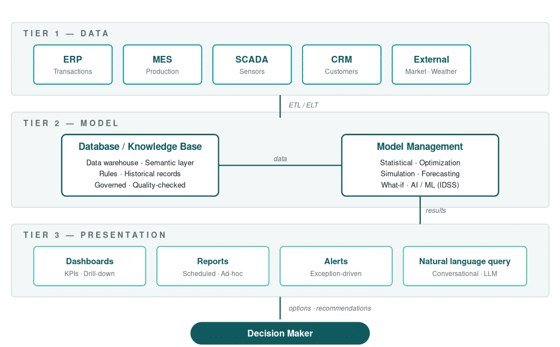
In a simple decision support system diagram, the flow is straightforward: internal and external data sources feed the database or knowledge base; the model management system uses that data to evaluate options; and the user interface presents those results to the person making the decision. The decision maker then acts on the recommendation, scenario, or comparison.
Types of decision support system
A common question is types of decision support system or what are the four types of decision support systems. In practice, one of the most widely used classifications is Daniel Power’s five-part taxonomy: data-driven, model-driven, knowledge-driven, document-driven, and communication-driven DSS. Some simplified summaries collapse or omit one category, which is why readers sometimes encounter “four types,” but the fuller taxonomy uses five.
Data-driven DSS
A data-driven DSS focuses on large collections of structured data. It commonly relies on file systems, data warehouses, OLAP, and data mining. These systems are strongest when the decision depends on exploring historical data, filtering scenarios, and comparing performance patterns across many records – the domain traditionally called descriptive analytics and, increasingly, diagnostic analytics.
Model-driven DSS
A model-driven DSS centers on analytical models rather than massive datasets. Common examples include accounting models, financial models, optimization routines, simulation, scheduling logic, and what-if analysis. This type most closely aligns with what modern literature calls prescriptive analytics — systems that recommend a course of action, not just display data. These systems are especially useful when users need to test assumptions or compare outcomes under changing constraints.
Knowledge-driven DSS
An Intelligent DSS (IDSS) extends the traditional model by adding AI/ML capabilities such as predictive analytics models, NLP, adaptive learning, and more automated recommendations. As IDSS recommendations become more consequential, explainable AI (XAI) — the ability to trace and justify how a model reached its suggestion — becomes a critical design requirement.
Document-driven DSS
A document-driven DSS helps users retrieve and use unstructured content such as policies, reports, documents, manuals, and web content. Search, text mining, and document retrieval are typical features. This type has become increasingly relevant as organizations try to connect formal data with text-heavy operational knowledge.
Communication-driven DSS / GDSS
A communication-driven DSS, often discussed as Group DSS (GDSS), supports collaborative decision making. Typical features include collaborative platforms, shared workspaces, voting, and consensus-building. These systems matter when the decision is made by a group rather than by an individual manager.
An additional, more academic taxonomy by Haettenschwiler divides DSS into passive, active, and cooperative systems. That classification appears less often in modern commercial content, but it is still useful when discussing how much the system only informs, how much it suggests, and how much it collaborates with the user.
| Type | Dominant component | Typical technology | Example use case |
| Data-driven | Large data stores | OLAP, data warehouse, data mining | Sales analytics, OEE dashboards |
| Model-driven | Analytical models | Optimization, simulation, financial models | Production scheduling, portfolio allocation |
| Knowledge-driven | Rule base / expert rules | Rules engines, expert systems, AI advisors | Credit scoring, clinical alerts |
| Document-driven | Document repositories | Search, text mining, knowledge management | Legal research, policy lookups |
| Communication-driven (GDSS) | Collaboration platform | Shared workspace, voting, consensus tools | Strategy workshops, emergency response |
How a DSS works
A DSS works by moving data through a structured decision flow. Internal systems such as ERP, MES, SCADA, CRM, and CMMS provide core business or operational data. External signals such as market conditions, weather, or regulatory inputs enrich that view. The database or knowledge base stores and organizes those inputs, the model layer processes them, and the user interface presents results in a form a human can act on.
That architecture makes DSS useful across decision levels and is one reason why data-driven decision making has moved from an aspiration to a practical reality in many organizations. At the strategic level, executives may use it for investment, capacity, risk, or portfolio decisions. At the tactical level, managers may use it for planning, prioritization, and trade-offs across business units or plants. At the operational level, analysts or supervisors may use it for day-to-day scheduling, exception handling, quality signals, or response choices.
This is also why DSS remains distinct from routine reporting. MIS is excellent at structured summaries and recurring reports. DSS becomes more relevant when the decision is less routine, more conditional, or more sensitive to uncertainty. In that sense, the system supports the full path from information to decision to action.
DSS data flows
The standard DSS data flow has five stages: sources, integration, modeling, presentation and decision.
- Sources – internal operational systems (ERP, MES, SCADA, CRM, CMMS) and external feeds (market data, weather, regulatory) push data into the DSS.
- Integration – ETL/ELT pipelines clean, transform and load the data into the database or data warehouse layer.
- Modeling – the model management system applies the selected model (statistical, optimization, simulation, forecasting) to the prepared data. Depending on the model, this step can deliver descriptive, predictive, or prescriptive analytics output.
- Presentation – the UI displays dashboards, recommendations, alerts or scenario outcomes to the user.
- Decision – the human decision maker evaluates the output, accepts,rejectsor modifies it, and commits the action back to the operational systems.
Herbert Simon’s 1960s model of decision making – intelligence, design and choice – maps cleanly to the DSS data flow. In the intelligence phase, the system surfaces the problem and the relevant data. In the design phase, models generate alternatives and project consequences. In the choice phase, the user picks an alternative and the DSS records the decision, which can then be fed back as training data for future recommendations. This three-phase decomposition underlies most modern DSS design.
DSS architecture
At the architectural level, a DSS is a three-tier system. The data tier holds structured operational data, unstructured documents and a governed semantic layer. The model tier hosts the analytical engines, model library, rules and any AI components. The presentation tier delivers the interface – dashboards, mobile apps, conversational UIs or embedded panels inside another application.
Deployment patterns range from standalone DSS (a dedicated application), to integrated DSS (embedded inside an ERP or MES), to web-based and cloud-native DSS, to on-premises systems for regulated or latency-sensitive environments. The choice reflects where the data already lives and what the security and latency constraints are.
Intelligent DSS (IDSS): AI and ML inside decision support
An Intelligent DSS (IDSS) extends the traditional model by adding AI/ML capabilities such as predictive analytics models, NLP, adaptive learning, and more automated recommendations. As IDSS recommendations become more consequential, explainable AI (XAI) — the ability to trace and justify how a model reached its suggestion — becomes a critical design requirement. TechTarget and CIO both describe current DSS as increasingly influenced by AI and machine learning, while Qlik notes that many modern DSS variants use AI/ML to suggest insights or analyses for humans to act on.
This is where the distinction between DSS vs AI becomes important. A DSS is a decision support structure: it combines data, models, and interface to help a human make a choice — the foundation of data-driven decision making. AI is a set of techniques that can power part of that structure.
In industrial settings, Smart RDM fits this IDSS direction clearly. Its official materials describe AI as a layer that analyzes, predicts, suggests, and supports users in making decisions in real time, based on full IT/OT context. It also describes dashboards that combine KPIs, analyses, alerts, AI/ML recommendations, and process events in one place, which is a strong practical expression of AI-powered decision support rather than analytics in isolation.
DSS in manufacturing
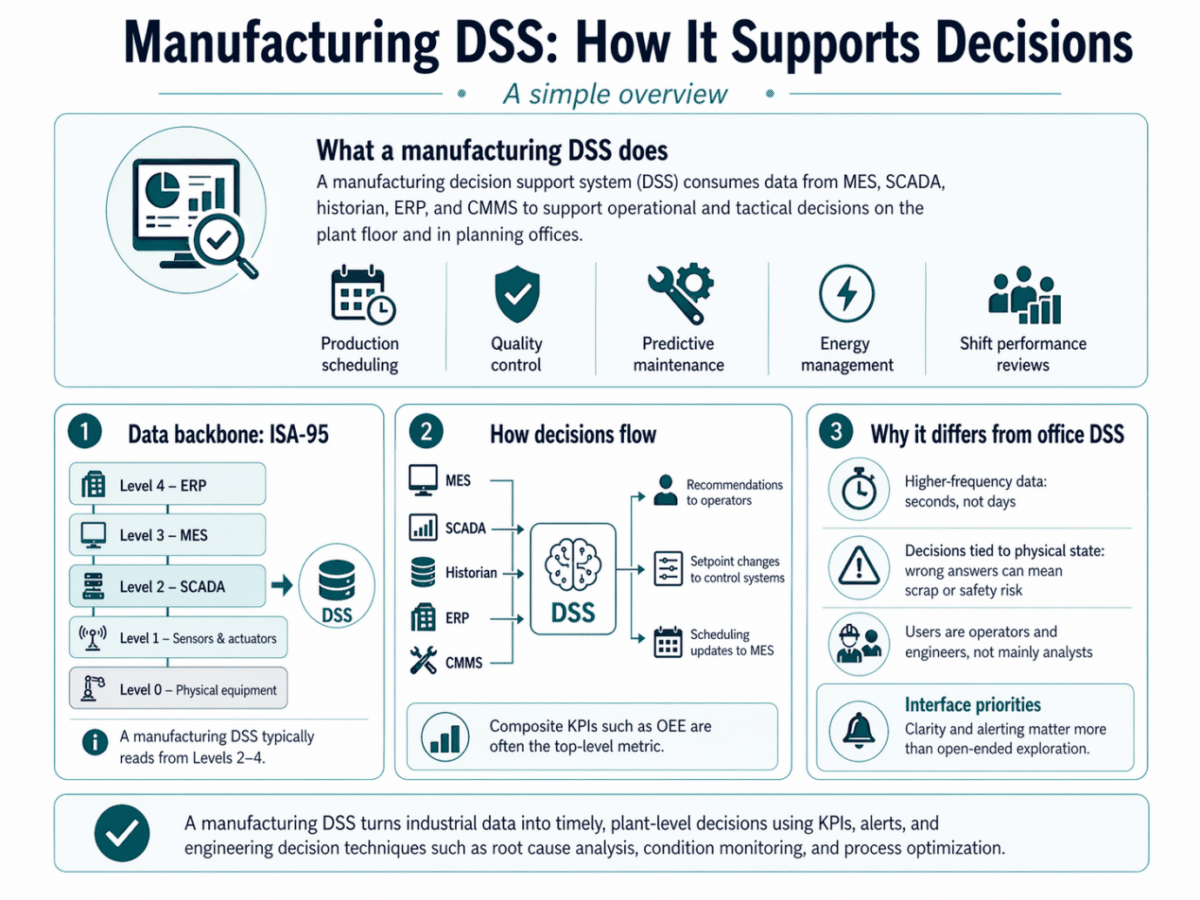
A manufacturing DSS is a vertical instance of the broader DSS concept. It uses plant and enterprise data — bridging OT and IT systems — to support decisions about production, quality, scheduling, downtime response, predictive maintenance, and other operational choices. In architectural terms, it typically consumes data from MES, SCADA, historians, ERP, CMMS, and industrial data platforms.
This article keeps manufacturing examples brief because several related topics have their own dedicated guides. Production scheduling, OEE, predictive maintenance, root cause analysis, anomaly detection, and manufacturing analytics all deserve separate treatment. Here, it is enough to say that a manufacturing DSS provides the decision layer above those signals and models: it helps users compare options, understand implications, and choose the next action with proper industrial context.
For Smart RDM, this is one of the clearest vertical fits. The platform describes itself as a central analytical environment that combines OT and IT data, dashboards, alerts, AI-supported models, and process context to support operational and strategic decision-making. Its manufacturing pages frame that explicitly as better decisions across machines, lines, and whole plants, which is precisely the manufacturing DSS angle that is still underrepresented in general-purpose search results.
Clinical decision support system (CDSS) and DSS in healthcare
A clinical decision support system (CDSS) is a healthcare-specific DSS integrated with clinical workflows. In practice, CDSS uses EHR data, clinical guidelines, patient context, and rules or models to support diagnosis, treatment selection, prescribing, and safety checks. One of its best-known functions is generating drug interaction alerts and other safety warnings during care delivery.
Interoperability is central in this vertical. HL7 and FHIR matter because clinical decision support increasingly relies on structured exchange of patient data between EHR systems and external CDS services. HL7 documents FHIR as a standard for exchanging healthcare information electronically, and CDS implementations increasingly use FHIR-based patterns to integrate alerts and guidance into EHR workflows.
That is why decision support system in healthcare is not just a generic example. It is one of the strongest vertical manifestations of DSS: highly regulated, tightly integrated with workflow, and heavily dependent on context, alerts, and standardized data exchange.
DSS in supply chain, finance, and marketing
A supply chain DSS typically supports demand forecasting, inventory optimization, supplier scoring, and logistics decisions. It often draws heavily on ERP data and external signals such as lead-time changes, supplier updates, or market conditions. This makes it a classic example of a DSS that combines internal and external inputs to improve planning under uncertainty.
A financial DSS usually focuses on risk analysis, portfolio decisions, credit scoring, and compliance-related decisions. Model-driven logic is especially common here because scenario analysis, scorecards, and optimization models are central to financial decision making.
A marketing decision support system supports campaign analysis, customer segmentation, and pricing decisions. Marketing DSS often combines customer or CRM-style data with models that estimate likely outcomes under alternative strategies, which makes it one of the clearest examples of DSS outside classical operations or finance.
DSS vs MIS vs expert system vs BI
The boundary between DSS and related systems is important because many readers search for these comparisons directly.
A Management Information System (MIS) is centered on structured reports, routine summaries, and operational information delivery. It is excellent for repeating reporting needs. A DSS extends beyond that by helping with semi-structured and unstructured problems where the user needs scenarios, trade-offs, or alternative options rather than a fixed report alone.
An Expert System is related to DSS but not identical. Expert systems use knowledge rules and an inference engine to simulate expert judgment. DSS, by contrast, is broader and more explicitly human-centered: it is designed to support the decision maker, not necessarily automate the decision itself. Knowledge-driven DSS sits closest to expert systems, which is why the two are often discussed together.
Business Intelligence (BI) is broader than DSS in platform scope. BI focuses on data preparation, reporting, OLAP, data visualization, and ETL/ELT across the organization. DSS can be seen as a purpose-built decision layer or component inside a BI ecosystem, especially when the goal is to support a specific decision rather than to provide general analytical visibility.
An Executive Information System (EIS) is commonly described as a specialized form of DSS for senior executives. It emphasizes high-level KPIs, ease of use, and drill-down from summary views. In practice, EIS is the C-suite-facing branch of the broader DSS family.
| System | Primary purpose | Decision type | Human role |
| MIS (Management Information System) | Structured reports, routine summaries | Structured | Reader |
| DSS | Interactive analysis, what-if, recommendations | Semi-structured | Decision maker |
| Expert System | Rule-based automated decision | Structured within domain | Reviewer / override |
| EIS (Executive Information System) | High-level KPIs for C-suite | Strategic | Executive reviewer |
| BI (Business Intelligence) | Broad reporting, dashboards, analytics | Mixed | Analyst / consumer |
| ERP | Transaction processing, operational record | Structured workflows | Operator |
Advantages and disadvantages of DSS
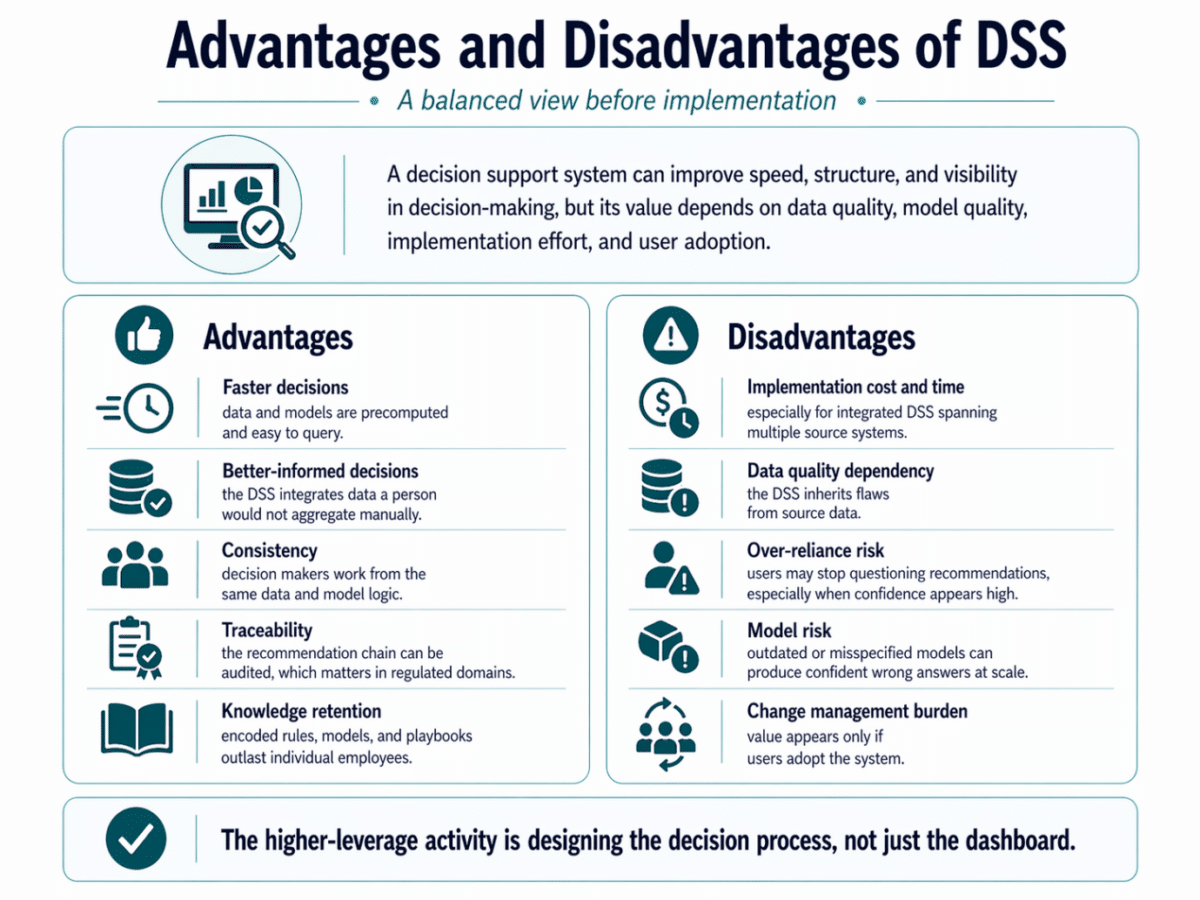
The main advantage of DSS is that it improves the quality and speed of decisions when the problem is too complex for static reporting alone. It helps users sift large volumes of data, compare alternatives, and structure uncertainty in a more usable way. That is why DSS remains relevant across business, healthcare, and industrial contexts.
A second advantage is flexibility. DSS can support strategic, tactical, and operational decisions, and can be embedded in ERP, web-based, cloud-based, or on-prem systems. It also works across verticals, from clinical care to supply chain to manufacturing.
The main disadvantages are equally practical. DSS can be costly to implement, vulnerable to poor-quality data, and prone to information overload if the interface or model logic is weak. There is also the risk that users over-trust outputs without understanding underlying assumptions, which is why data governance, explainable AI practices, and data quality still matter.
DSS software and vendor landscape 2026
Smart RDM belongs in this landscape from the industrial side. It is not a generic encyclopedia or BI explainer. It is an industrial data and AI platform that provides governed data flows, analytics, AI/ML support, dashboards, alerts, and role-based decision views for manufacturing, energy, and utilities. That makes it particularly relevant to the manufacturing DSS angle, which remains a gap in the broader search landscape.
How to choose and implement DSS
Choosing DSS starts with the decision problem, not the software. Teams should first clarify whether the target problem is strategic, tactical, or operational; whether it depends mainly on data exploration, model comparison, rules-based guidance, documents, or collaboration; and whether the main users are executives, managers, analysts, operators, or clinicians. Those choices usually determine the right DSS type before they determine the right vendor.
From there, implementation usually follows a straightforward sequence: assess → design → build → deploy → evaluate. Assessment defines the decision problem, data sources, and success criteria. Design defines the architecture, models, interfaces, and governance rules. Build integrates the data and models. Deploy introduces the system into real workflows. Evaluate checks whether the DSS is actually improving the quality, speed, or consistency of decisions.
For industrial teams, Smart RDM’s fit is strongest when the goal is not just another dashboard, but a governed decision layer on top of OT/IT data. Its pages on monitoring, analysis, decisions, big data analytics, and AI process optimization describe exactly that pattern: data integration, model execution, contextual dashboards, and decision support aligned with real operational workflows.
FAQ
What is an example of a DSS?
A DSS example depends on the vertical. In healthcare, a clinical decision support system can generate drug interaction alerts from EHR data. In manufacturing, a DSS can combine MES, SCADA, historian, and ERP data to support plant decisions. In marketing, a marketing decision support system can support campaign analysis and pricing choices.
What are the 4 components of DSS?
Many summaries list four components by separating the database and knowledge base. In practice, the classic architecture is a database or knowledge base, a model management system, and a user interface, with the knowledge base sometimes treated as a separate fourth element.
What is the difference between DSS and AI?
A DSS is a system designed to support human decisions by combining data, models, and interface logic. AI is a set of techniques that can power part of that system, especially in an Intelligent DSS, but AI can also automate tasks or judgments outside a DSS context.
What are the four types of decision support systems?
Many simplified explanations mention four, but one of the most widely used classifications actually uses five types: data-driven, model-driven, knowledge-driven, document-driven, and communication-driven DSS.
What is DSS software?
DSS software is software built to help users make better decisions by analyzing data, applying models or rules, and presenting outputs such as reports, dashboards, recommendations, or scenarios. It can be standalone, embedded in enterprise systems, web-based, cloud-based, or on-prem.
How is DSS used in business?
DSS is used in business for planning, pricing, risk analysis, portfolio management, supply chain decisions, budgeting, campaign analysis, and executive decision support. The common pattern is the same across functions: collect relevant data, analyze alternatives, and present decision-ready output.
What is DSS in manufacturing?
DSS in manufacturing is the use of decision support logic to help plant teams make better production, quality, scheduling, and maintenance-related decisions using MES, SCADA, historian, ERP, and other industrial data sources. It supports plant decisions without needing to replace the underlying operational systems.
What is DSS in healthcare?
DSS in healthcare usually refers to clinical decision support. It uses EHR data, clinical guidelines, and standards such as HL7/FHIR to support diagnosis, prescribing, and drug-safety decisions through context-aware alerts and recommendations.
What is marketing DSS?
A marketing decision support system supports campaign analysis, customer segmentation, and pricing decisions by combining marketing data with models that estimate likely outcomes under alternative strategies.
What is DSS in supply chain?
A supply chain DSS supports demand forecasting, inventory optimization, logistics, and supplier scoring by combining ERP data with external context such as lead times or market changes.
What is DSS in finance?
A financial DSS supports risk analysis, portfolio optimization, credit scoring, and compliance-oriented decisions using model-driven and data-driven logic.
DSS vs MIS – what is the difference?
MIS is centered on routine structured reports and summaries. DSS is more relevant when the decision is semi-structured or unstructured and the user needs scenarios, alternatives, or trade-off analysis.
DSS vs expert system – what is the difference?
An expert system uses rules and an inference engine to emulate expert reasoning. A DSS is broader and remains focused on supporting the human decision maker, even when it uses knowledge-based or expert-style components.
DSS vs BI – what is the difference?
BI is the broader technology stack for data preparation, reporting, OLAP, and visualization. DSS is a more purpose-built decision layer that uses data and models to support a specific choice or decision process.
DSS vs ERP – what is the difference?
ERP is the transactional enterprise system that records and organizes business operations across modules such as finance, HR, and supply chain. DSS often consumes ERP data and may sometimes be embedded inside ERP environments, but it serves a different purpose: decision support rather than transaction execution.
What are advantages and disadvantages of DSS?
Advantages include better decision quality, faster evaluation of alternatives, and improved handling of semi-structured decisions. Disadvantages include implementation cost, dependence on data quality, and the risk of information overload or weak assumptions.
What is a DSS diagram?
A DSS diagram is a simplified visual of the system’s architecture. It typically shows internal and external data sources feeding a database or knowledge base, a model management layer processing that data, and a user interface presenting results to the decision maker.
Final takeaway
A decision support system (DSS) is not just a reporting tool and not just an AI engine. It is a structured decision environment that combines data, models, and interface logic to help people make better decisions under uncertainty — through descriptive, predictive, and prescriptive analytics presented in an actionable form. That is why DSS remains relevant across business, healthcare, supply chain, finance, marketing, and manufacturing.
For Smart RDM, the most important angle is the manufacturing one. Smart RDM fits the DSS category where industrial teams need a governed layer that turns OT and IT data into actionable dashboards, alerts, recommendations, and role-based decisions in real operational conditions. That positioning is especially useful because manufacturing DSS is still undercovered in the broader search landscape.


Light mode