
How does Predictive Maintenance impact investment planning?

Gabriela Gic-Grusza
Investment planning for machine infrastructure can be based on reliable data
In many companies, investment decisions related to production assets have traditionally been made based on experience, the pressure of current failures, equipment age, or the opinion of the maintenance team. These are all important sources of knowledge, but they may not be sufficient on their own.
Having two machines purchased at the same time does not mean they must operate in the same way. One may run reliably, while the other may generate increasing costs, downtime, failures, and risk for production.
That is why an approach in which machine investments are planned not only according to equipment age, but also according to actual asset condition, operating history, failure risk, maintenance costs, and impact on production, is much more justified. In asset management terms, this is called asset investment planning (AIP) – and it marks the shift from reactive budgeting to data-driven capital allocation.
This is where Smart RDM can extend the classic approach to Predictive Maintenance into the area of strategic investment planning – bridging asset lifecycle management with day-to-day condition monitoring.
From maintenance to CAPEX planning
Predictive Maintenance is most often associated with predicting failures. This is a very important element, but the information collected – from condition monitoring sensors, CMMS records, and process historians – can be used much more broadly.
If a system can analyze machine operating data, detect risks, monitor events, and assess the effectiveness of predictions, the same data can also support investment decisions, such as:
- which machines require modernization,
- which assets should be replaced first,
- which machines are still safe to operate,
- where failures generate the highest cost,
- where an investment may deliver the greatest return,
- which production areas carry the highest technological risk,
- how to phase investments over time.
In this way, Smart RDM can support not only maintenance teams, but also production directors, technical directors, executive teams, and people responsible for CAPEX planning.
The challenge: machines and components age unevenly
Machine age is a simple indicator, but it should not be the only investment criterion.
A machine may be 15 years old and still operate reliably because it is well maintained, has a low workload, and does not generate critical failures.
Another machine may be only 6 years old, but operate in more demanding conditions, under a high workload, with frequent stoppages, recurring failures, and increasing maintenance costs.
That is why the better question is not:
How old is the machine?
But rather:
What is its actual operational and economic condition? This is the essence of condition based maintenance – decisions driven by real asset health data, not calendar intervals.
Smart RDM makes it possible to look at the machine park from exactly this perspective.
What data helps plan investments?
Investment planning requires data from several areas. The better these data sources are connected, the more reliable the machine ranking and investment recommendation will be.
| Data area | Examples |
| Machine operating data | operating time, number of cycles, workload, operating modes |
| Process data | temperatures, pressures, vibrations, flows, process parameters |
| Maintenance events | failures, interventions, inspections, parts replacements |
| Downtime data | downtime duration, cause, impact on production |
| Costs | parts cost, labor, downtime cost, service cost |
| Quality | quality deviations, complaints, production losses |
| Criticality | impact of the machine on production, safety, and the environment |
| Investment data | replacement cost, modernization cost, availability of alternatives |
The greatest value does not come from the amount of data alone, but from connecting that data to a specific machine, production line, and business impact.
Machine ranking: how to make effective decisions?
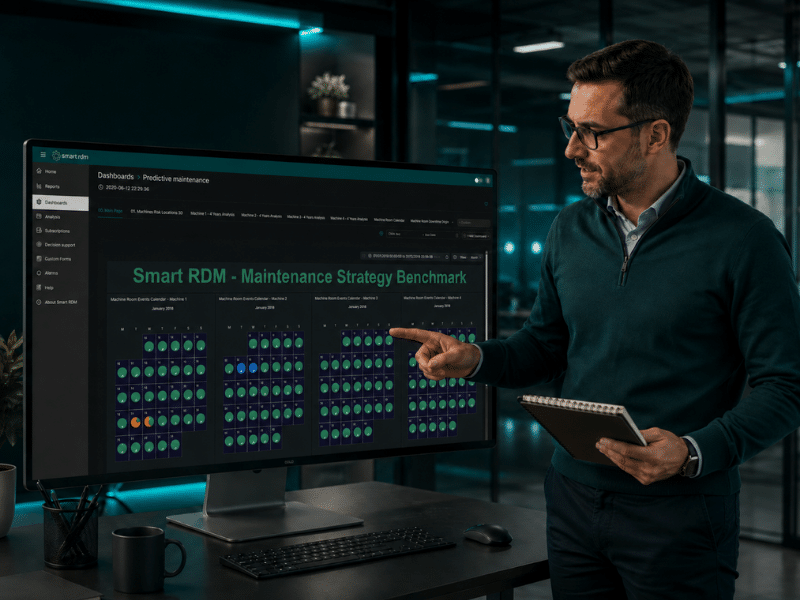
One of the most important advantages may be the ability to create a machine ranking. This is possible in Smart RDM and brings many benefits.
A machine ranking is an organized list of assets designed to show which machines carry the highest risk for operational continuity, costs, and business performance from the perspective of reliability and failure risk. In industry terms, this process is known as asset criticality assessment – a foundational step in any asset investment planning program.
The ranking should not answer only the question of which machine had the most failures. It should show which machines generate the greatest risk for the business.
Example ranking criteria:
| Criterion | What it shows |
| Failure risk | probability of a problem occurring |
| Time to potential failure | expected risk horizon |
| Number of events (MTBF) | frequency of failures and interventions |
| Downtime (OEE impact) | impact on production availability |
| Maintenance cost (TCO) | how much the machine costs to operate and maintain |
| Criticality | impact of failure on production |
| Data quality | reliability of the assessment |
| Deterioration trend (P-F curve) | whether the machine condition is progressing along the failure curve over time |
| Modernization cost | whether repair still makes sense |
| Potential ROI | whether the investment can pay off |
The result is a list of assets that can be divided into categories:
| Category | Meaning |
| Replace | high risk, high costs, low profitability of continued maintenance |
| Modernize | critical machine, but still possible to improve |
| Monitor | risk is increasing, but an investment decision is not yet urgent |
| Maintain | machine operates reliably, with no clear basis for investment |
| Validate data | insufficient data for a reliable decision |
A well-structured machine ranking and assessment criteria make it possible to extend the maintenance strategy into informed investment planning.
Predicting machine lifetime
The next step is predicting the remaining lifetime of a machine or component, which is an approach similar to Remaining Useful Life, or RUL. This means the estimated remaining period during which a machine can continue operating before it reaches a defined failure threshold or requires maintenance intervention. Modern RUL estimation typically combines machine learning models with sensor data and historical maintenance records.
In the right approach, the goal is not for the system to magically indicate one exact replacement date. The goal is to use data to show the trend and the risk.
Smart RDM can help answer questions such as:
- Is the machine condition deteriorating faster than before?
- Is the number of failures increasing?
- Are failures becoming more serious?
- Are maintenance interventions becoming less effective?
- Is the maintenance cost increasing?
- Is the machine approaching the limit of economically viable operation?
- Would replacement next year be a better decision than another expensive modernization?
Thanks to this, the investment plan can be based on scenarios:
| Scenario | Decision |
| The machine operates reliably | no investment, continue monitoring |
| Risk is increasing, but the cost is low | preventive actions |
| Risk is increasing and the machine is critical | modernization or budget preparation |
| Maintenance cost exceeds the threshold | replacement analysis |
| Frequent failures affect production | investment priority |
| Lack of data | improve monitoring first |
Data as an argument in conversations with management
One of the biggest challenges for technical departments is justifying investments – building a predictive maintenance business case that speaks the language of finance: ROI, total cost of ownership, and risk-adjusted returns.
The maintenance team often knows which machines are problematic. The challenge appears when the budget has to be justified:
- Why should this machine be replaced now?
- Why is this investment more important than another one?
- What will happen if we postpone it by one year?
- What is the cost of continuing to maintain the current asset?
- What risk does production carry?
A system such as Smart RDM can help prepare a data-based answer:
- failure history,
- deterioration trends,
- number and cost of interventions,
- impact on downtime,
- production risk,
- comparison with other machines,
- recommended investment priority.
As a result, investments are planned based on data, not intuition.
The impact of failures on the investment roadmap
The greatest value lies in creating an investment roadmap for the machine park – a practical tool for asset lifecycle management that connects today’s condition data with long-term capital planning.
Such a roadmap may show:
| Time horizon | Example decision |
| 0–3 months | urgent protective actions |
| 3–6 months | modernization of critical components |
| 6–12 months | budget preparation for replacement |
| 12–24 months | CAPEX plan for a group of machines |
| 24+ months | long-term machine park renewal strategy |
Thanks to this, Smart RDM can support not only day-to-day maintenance, but also strategic technical planning.
Use case example: production machines
Imagine a plant with 80 key production machines. All of them are important, but the investment budget allows only 5 of them to be replaced in the coming year.
Without data, the decision may be based on machine age, production pressure, or the most visible problems.
With Smart RDM data, a ranking can be prepared:
| Machine | Failure risk | Maintenance cost | Downtime | Criticality | Recommendation |
| Line A / Drive 1 | high | high | high | critical | replace |
| Pump P-204 | high | medium | medium | high | modernize |
| Compressor S-12 | medium | high | low | high | cost analysis |
| Fan W-08 | low | low | low | medium | maintain |
| Conveyor T-17 | no data | unknown | unknown | high | improve monitoring |
This represents a completely different quality of investment decision-making.
How to support investment planning in practice
In summary, Smart RDM can be used as an analytical and decision-support layer in investment planning for the machine park.
1. It collects equipment data
The system organizes information about machines, their operation, failures, events, alerts, and historical data – integrating with CMMS, EAM, and SCADA systems to create a unified asset health view.
2. Itvalidatesdata quality
Not every decision can be made immediately. If the data is incomplete, the system should make that visible. Missing data is also information – it means that IT/OT integration and data quality must be improved first.
3. It creates a machine ranking
Assets can be compared based on risk, costs, failure frequency, downtime, criticality, and data quality.
4. It predicts condition deterioration
Based on trends, it is possible to assess which machines are approaching the limit of economically viable operation.
5. It connectsPdMwith CAPEX
Failure prediction can be extended into investment recommendations: maintain, monitor, modernize, or replace.
6. It helps justify the budget
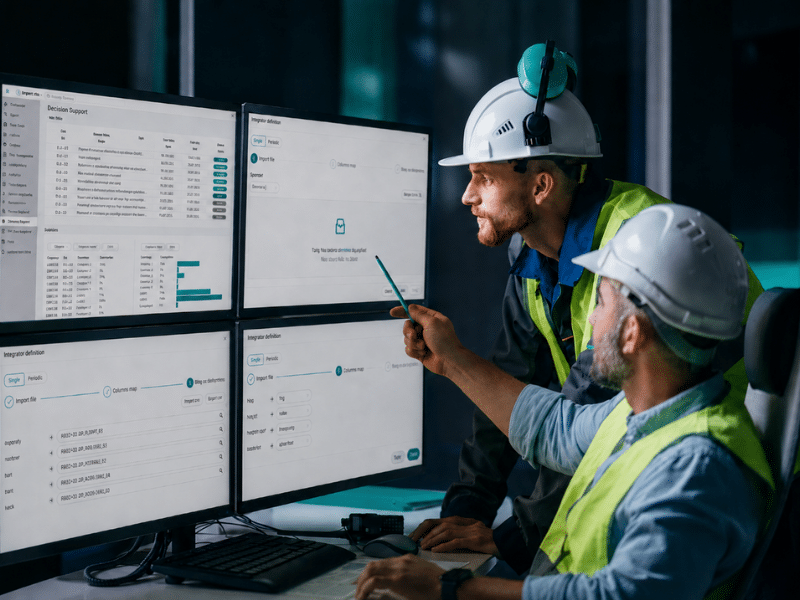
Reports and dashboards can be used in conversations with management, finance, and production teams.
Predictive Maintenance is more than failure prediction
Predictive Maintenance does not have to stop at predicting failures. When combined with data on machine condition, costs, downtime, and asset criticality, it can become real support for investment decisions. With Smart RDM, industrial companies can plan the future of their machine park more consciously: identifying which assets need to be replaced, which are worth modernizing, and which can continue to operate safely. This is the shift from reactive maintenance to strategic, data-driven management of production assets – where predictive maintenance cost savings translate directly into smarter capital allocation and measurable ROI.
Light mode