

MLOps for Predictive Maintenance

Sebastian Dudzik
How to Maintain Predictive models in a production environment
Predictive Maintenance has today achieved a high level of algorithmic maturity. Predictive models, including hybrid models combining physics-based knowledge with machine learning, can effectively identify symptoms of degradation and impending failures – estimating remaining useful life (RUL) of critical components with increasing accuracy. Their effectiveness has been confirmed in both real industrial deployments and scientific research.
The challenge is no longer about creating a model that works under test conditions. The real difficulty begins when the same model is expected to operate in a production environment for months or years, supporting real maintenance decisions under changing operational conditions. This is where MLOps – the discipline of managing the full machine learning lifecycle in production – becomes essential.
Why PdM models lose effectiveness after deployment
A predictive model in maintenance always operates within a specific operational context. It learns the relationships between signals and the technical condition of the equipment under a specific load, installation configuration, and control strategy. Over time, the mode of operation of the installation changes, even if this is not related to a formal modernization.
These changes may result from:
- a different load profile,
- changes in raw materials or media quality,
- control strategy adjustments,
- natural equipment wear,
- optimization actions introduced by operators.
As a result, data that previously indicated a non-standard state or impending failure begins to correspond to a normal operating mode. In MLOps terminology, this is known as data drift (when input distributions shift) or concept drift (when the relationship between inputs and the target changes). The model does not stop functioning mathematically, but gradually ceases to reflect the current operational reality of the installation.
From the user’s perspective, this manifests as an increasing number of false alarms (declining precision), a decline in prediction accuracy (declining recall), or a loss of trust in the system, even though the model initially functioned correctly.
The role of algorithms and hybrid models
The described phenomenon does not mean that Predictive Maintenance algorithms are insufficient. Quite the opposite. The application of advanced algorithms, and particularly hybrid models, aimed to limit the impact of operating condition variability on prediction quality.
However, even physics-informed hybrid models require lifecycle management:
- monitoring for performance degradation,
- controlled retraining,
- and governed deployment – which is precisely the role of MLOps.
However, they do not eliminate the need for maintaining models in production. They reduce the rate at which the model diverges from the actual operating mode of the installation, but do not replace conscious management of the model lifecycle.
What MLOps for Predictive Maintenance means in practice
MLOps in Predictive Maintenance does not consist of constantly “fixing AI.” Its goal is to ensure that the model operates under the conditions for which it was designed throughout its usage period, and that moments of significant change are identified sufficiently early.
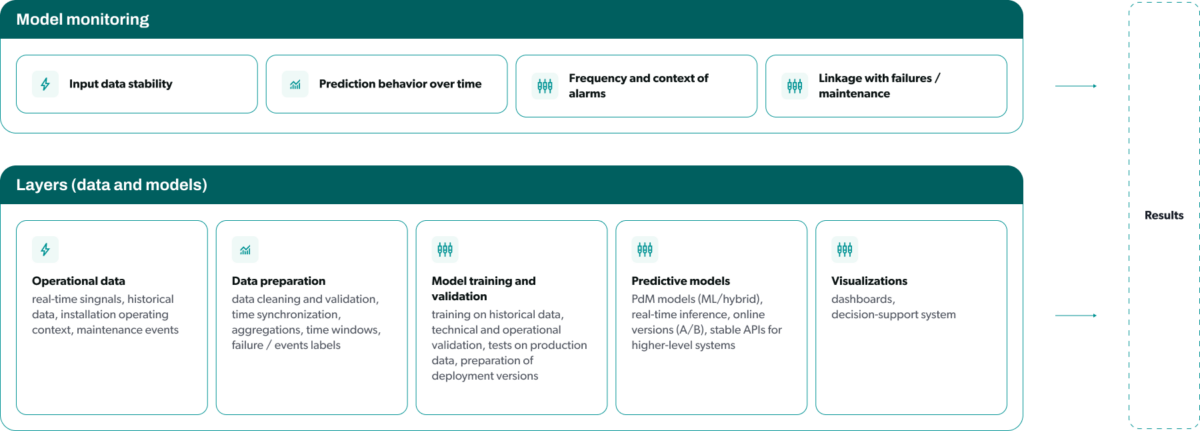
In practice, this means treating the PdM model as an element of the operational system, rather than a one-time analytical component. Every model should have a clearly defined lifecycle – from development through validation to production deployment – managed through a model registry that tracks versioning of the model, training data, and input signal configurations.
Model monitoring in a production environment
In an industrial environment, rapid feedback on prediction correctness is not always available. Therefore, monitoring of PdM models cannot be limited to classical statistical metrics.
In practice, one monitors:
- stability of input data distributions – detecting data drift before it degrades predictions,
- changes in signal characteristics – identifying concept drift or sensor degradation,
- frequency and context of generated alarms – tracking precision/recall trade-offs over time,
- correlation of predictions with actual maintenance events – the ultimate measure of operational relevance.
The goal of monitoring is to detect the moment when the model ceases to be consistent with the current mode of operation of the installation before it impacts operational decisions.
Controlled model retraining
Retraining of PdM models should be a controlled and repeatable process. It is not a reaction to a single error, but a conscious decision resulting from a change in operational conditions.
Typical triggers for retraining include:
- a permanent change in the installation’s operating profile,
- modernization or reconfiguration of equipment,
- the emergence of new operating modes,
- prolonged deviations in data behavior.
In a production environment, the ability to test new model versions in parallel – using shadow mode or champion-challenger patterns – and gradually switch them to operational work without the risk of system destabilization is key. If a new version underperforms, a governed rollback to the previous version must be possible without operational disruption.
Integration of MLOps with maintenance processes
A predictive model that is not linked to the actual decision-making process loses its operational value. MLOps must consider the way the organization responds to predictions: who analyzes them, what actions are taken (e.g., work orders in CMMS), and within what timeframe – closing the loop between prediction and operational execution..
Feedback from the execution of maintenance work orders constitutes a key element of model improvement – enabling continuous training (CT) where verified outcomes refine future predictions. It allows not only for evaluating prediction accuracy but also for adapting models to the plant’s real operational practices.
MLOps as a condition for scaling Predictive Maintenance
Without mature MLOps – assessed against recognized maturity levels from manual workflows (Level 0) through automated ML pipelines with continuous training (Level 1) to full CI/CD for models (Level 2) – Predictive Maintenance remains a collection of local deployments whose effectiveness declines over time. Only a systemic approach to model maintenance allows for:
- stable PdM operation in the long term,
- scaling solutions between installations and locations – enabled by a shared model registry, standardized data pipelines, and reproducible training environments,
- building the operational organization’s trust in predictions – grounded in transparent model governance and auditability.
A predictive model does not stop working because the algorithm is wrong, but because the installation starts operating under different conditions than when the model was trained. MLOps in Predictive Maintenance consists of consciously managing this change.
Model maintenance architecture


Light mode