
From the mechanic’s ear to AI: The history of Predictive Maintenance

Gabriela Gic-Grusza

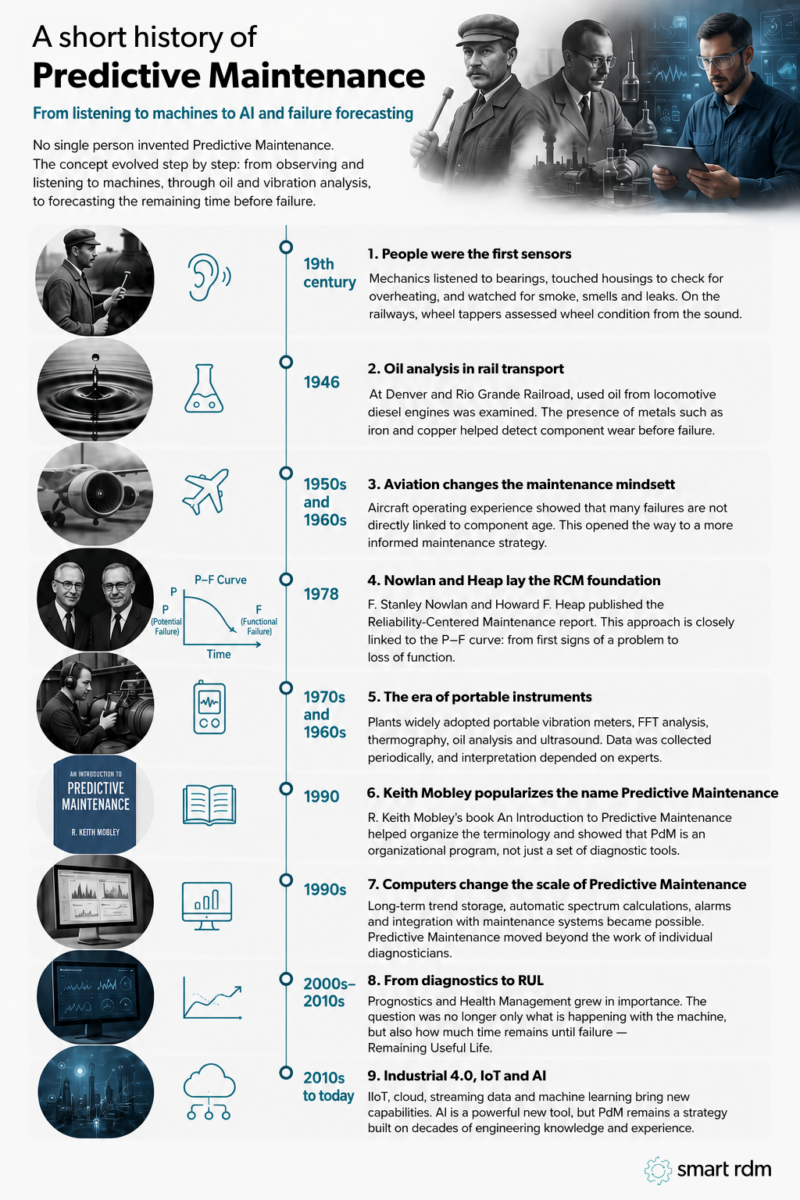
Predictive Maintenance did not begin as an advanced technology with an innovative name. For most of industrial history, machine condition was assessed using the human senses. An experienced mechanic could recognize a worn bearing by a change in sound, feel excessive motor vibration by hand, or notice an unusual exhaust color. Knowledge about the equipment was “stored” in the minds of the people who had operated it for many years.
Today’s Predictive Maintenance systems use sensors, historical data, mathematical models, and artificial intelligence. The goal, however, remains much the same: to identify signs of deteriorating equipment condition as early as possible and plan an appropriate response before a failure occurs.
The history of Predictive Maintenance is therefore a story of the gradual transition from relying on human empirical experience to knowledge that can be recorded, analyzed, and used across the entire organization.
First, companies repaired what had already broken
The first factories operated according to what we now call reactive maintenance. A machine continued running until it could no longer perform its function. Production was then stopped, the damaged component was located, and repairs began.
Under the conditions of 19th-century industrialization, this approach seemed natural. Many machines were relatively simple, production relied heavily on manual labor, and machine availability was not yet measured using a wide range of performance indicators. If a drive belt broke, it had to be replaced. If a shaft seized, it was repaired or replaced.
The growth of mass production changed the significance of equipment failures. As production lines became longer, the shutdown of a single machine could disrupt the operation of an entire plant. Downtime began to generate costs far greater than the repair itself. These included lost production, delays in customer deliveries, unproductive employee time, and the risk of damage to other parts of the installation.
As a result, industry began looking for ways to reduce the number of unexpected failures.
A maintenance schedule instead of chance
The answer was preventive maintenance. Inspections, component replacements, and overhauls began to be performed according to a defined schedule: after a specified number of operating hours, production cycles, or miles traveled.
This approach became particularly widespread during the first half of the 20th century, along with the development of railways, heavy industry, power generation, and aviation. It made it possible to prepare personnel, obtain spare parts and the right tools in advance, and plan maintenance shutdowns more effectively.
However, scheduled maintenance had a major limitation. Two identical machines can wear at different rates. Their condition is affected by environmental conditions, raw material quality, operating practices, load, installation errors, operating time, and many other factors. Some components were therefore replaced too early, even though they could still operate safely. Others failed before their scheduled inspection. This approach proved to be relatively costly.
It gradually became clear that the passage of time alone did not provide enough information about the actual condition of a machine.
Aviation changes the way Industry thinks about failure
Civil aviation had a major influence on the development of modern maintenance. In the 1950s and 1960s, increasingly advanced aircraft were being built, and the number of machines in operation was growing rapidly. Previously developed maintenance programs required a vast number of tasks to be carried out at fixed intervals.
Analyses conducted in the aviation industry showed that many failures did not follow a simple pattern related to component operating time. Some components showed signs of wear more quickly, while others could fail regardless of how long they had been in service. As a result, greater attention began to be paid to the function of the equipment, the consequences of a potential failure, and the actual mechanisms of degradation.
These experiences gave rise to Reliability-Centered Maintenance, or RCM. This approach involves selecting the appropriate maintenance strategy based on the importance of a given asset, how it is operated, and the consequences of its failure. NASA describes RCM as a continuous process that uses system operating data to improve both maintenance practices and equipment design.
An important element of this philosophy was Condition-Based Maintenance. Decisions about inspections or repairs were made based on information about equipment condition rather than solely on a date entered in the maintenance schedule.
Analyzing changes in equipment operation
Every developing fault causes certain changes in a machine. A bearing may begin to vibrate in a characteristic way. Friction causes temperature to rise. Component wear changes the composition of the oil. A leak affects pressure, flow, or energy consumption.
During the second half of the 20th century, industry began using a growing range of methods to observe these phenomena. These included:
- vibration analysis of rotating machinery,
- infrared thermography,
- oil and wear-particle analysis,
- ultrasonic testing,
- electrical diagnostics of motors,
- temperature, pressure, and flow monitoring.
Initially, measurements were taken periodically using portable instruments. A technician followed a designated route through the plant, collected data from individual machines, and then compared the results with previous readings. This made it possible to identify trends and determine which machines required closer inspection.
Programs implemented in the energy sector and heavy industry during the 1980s and 1990s increasingly combined vibration analysis, oil analysis, and thermography. In 1998, NASA described the implementation of a program in which traditional scheduled maintenance activities were replaced with Condition-Based Maintenance using vibration analysis, oil analysis, and thermal imaging cameras.
This was an important step toward Predictive Maintenance. Industrial plants were already able to detect signs of damage before a machine stopped operating.
From diagnosis to prediction
Condition-Based Maintenance primarily answers the question: “What condition is the equipment in?” Predictive Maintenance goes a step further and attempts to determine how that condition will change over time.
The development of industrial computers, technology, automation systems, and digital databases made it possible to collect an increasing number of measurements. Process data could be stored for many months and compared with the history of failures, overhauls, and component replacements. As a result, analysis was no longer limited to a single threshold crossing that triggered a machine alarm. It became possible to observe the rate of change, relationships between parameters, and recurring sequences of events.
For example, an elevated motor temperature does not necessarily indicate an approaching failure on its own. However, if it occurs together with increased vibration, a change in current consumption, and reduced performance, the combination of these signals may point to a specific technical problem.
This is how the modern understanding of Predictive Maintenance emerged: as a strategy that uses data to assess the probability of failure and predict how an abnormal condition will develop.
The industrial Internet opens a new chapter
At the beginning of the 21st century, relatively inexpensive sensors, industrial networks, and systems capable of storing large volumes of data became widely available. Increased equipment could be monitored continuously.
The development of the Industrial Internet of Things, or IIoT, and the Industry 4.0 concept meant that machine-condition data began to flow automatically. The system no longer had to wait for a technician’s periodic inspection route. Current information about temperature, pressure, vibration, and energy consumption was available almost in real time.
However, as the number of measurements increased, another challenge emerged. People could no longer analyze thousands of signals and identify every relationship on their own. Algorithms capable of recognizing patterns in data and greater automation of technology became necessary.
Research into modern Predictive Maintenance systems indicates that their main goals are to reduce costs, increase equipment availability, and improve reliability. These solutions use traditional statistical models, Machine Learning, and increasingly advanced analytical architectures.
Artificial Intelligence learns equipment behavior
Machine Learning made it possible to analyze relationships that could not easily be described using a single alarm threshold or a simple equation. An algorithm can learn what normal equipment operation looks like under different conditions and then identify deviations from that pattern.
In one case, the system classifies a specific type of failure. In another, it detects an anomaly even though a similar failure has never occurred before. More advanced models estimate the remaining period of safe component operation, known as Remaining Useful Life, or RUL.
Predictive Maintenance began to cover the entire process: from acquiring and organizing data, through analysis, to delivering information to the people responsible for equipment operation.
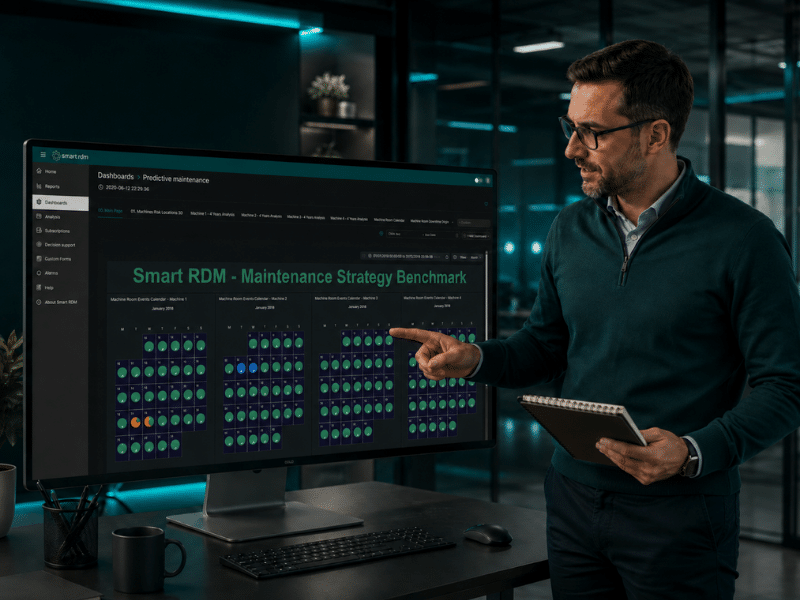
This approach is supported, among other things, by the technology available in Smart RDM. The platform integrates data from machines, sensors, and industrial systems and then enables it to be analyzed using mathematical models and artificial intelligence. AI algorithms learn normal equipment operating patterns, detect unusual changes in parameters, and help identify signs of developing faults. They can also assess the rate at which machine condition is deteriorating and support predictions of when maintenance intervention will be required. The results are presented in a format that is easy for maintenance teams to use, allowing technical signals to be translated into specific actions: inspecting the equipment, preparing spare parts, changing operating conditions, or scheduling a repair.
A Digital Twin organizes knowledge about
manufacturing plants
An important stage in the development of Predictive Maintenance was the use of digital twins. A digital twin is an accurate virtual representation of a physical asset, process, or system that is continuously updated using sensor data. It reflects the structure of the installation, the relationships between equipment, and the context of the collected data.
A temperature measurement has limited value until it is clear which machine it relates to, where the sensor is located, which component is being monitored, and under what conditions the equipment is operating. Context makes it possible to connect signals with technical documentation, maintenance history, process events, and employee knowledge.
In the Smart RDM methodology, building such a structured model is one of the elements involved in preparing an organization to implement Predictive Maintenance. It helps teams understand the process, identify critical equipment, and determine which data is needed to predict failures.
Technology can analyze enormous numbers of measurements, but interpreting the results correctly still requires process knowledge. Operators and maintenance personnel often know which signals are important, what normal machine behavior looks like, and under which conditions previous problems occurred.
Predictive Maintenance is becoming an
organizational process
Modern Predictive Maintenance goes beyond installing sensors and developing a mathematical model. It affects how decisions are made throughout the organization. Even a correctly detected anomaly will not deliver the expected result if the information does not reach the right person or if the team does not know how to respond. The system should therefore work together with daily maintenance processes, production planning, spare-parts management, and CMMS or EAM systems.
Feedback is also becoming increasingly important. After an inspection, an employee should confirm whether the model’s indication was correct, what type of fault occurred, and what action was taken. This data helps improve future predictions and trains the Predictive Maintenance system within the specific plant.
Implementing Predictive Maintenance is therefore a process developed in stages. It usually begins with selecting equipment through a machine-ranking process, focusing on assets whose failures are costly, frequent, or significant to safety and production continuity. The history of events, data availability, and the knowledge of people working with the installations are then analyzed. Only on this basis are the appropriate measurement and analytical methods selected.
Smart RDM brings these elements together in one environment, supporting process-data analysis as well as the management of events, technical knowledge, and model results.
The future: From predicting to recommending actions
The next stage of development is Prescriptive Maintenance, an approach in which the system also identifies possible actions. After detecting a developing abnormality, it can assess the impact of the fault on the process, recommend a suitable repair time, or suggest changing the machine’s operating parameters.
Interfaces based on generative artificial intelligence are also playing an increasingly important role. An employee can ask a question about a machine and receive an answer based on process data, manuals, service reports, and the history of similar events. This is how the Smart Chat module in Smart RDM works, allowing an operator to “talk” to the system.
The way technical knowledge is used is changing. Information that was previously scattered across spreadsheets, documentation, automation systems, and the memories of experienced employees can now be connected and made available across the entire organization.
Technology is moving forward, but the goal remains the same
The history of Predictive Maintenance began long before the emergence of artificial intelligence. It started with careful observation of machines and the experience of people who could recognize the first signs of a problem. Today, Predictive Maintenance uses far more advanced algorithms and tools. Its purpose is to help organizations predict instead of reacting, using AI and Machine Learning.
Where should a specific plant begin its Predictive Maintenance implementation? The Smart RDM team uses a proven methodology developed through customer implementations and based on practical experience as well as scientific and technological knowledge. It combines engineering expertise, data analysis, and the selection of appropriate models, allowing the entire process to be developed step by step in line with the organization’s needs.
Light mode