
Why MES alone is not enough for modern manufacturing?

Tomasz Węgrzyn
In many industrial plants, the conversation about digital transformation ends in the same place: “we need an MES system.” In an era of IIoT, advanced analytics, and Industry 4.0 expectations, that reflex deserves a second look. MES (Manufacturing Execution System) – a production execution system – is an application layer “between” ERP and automation (SCADA/PLC) that manages and records production execution at the operation level. And often that is true: MES can be an important piece of the puzzle. The problem begins when MES becomes the only answer to every question: efficiency, quality, energy, failures, reporting, ESG, planning, and even process safety.
The default choice of “always MES for production” worked in the past, when:
- data was “good enough,”
- processes were stable,
- reporting requirements grew slowly,
- and pressure on cost and energy was lower.
Today, however, advantage is built by companies that can work with data faster, broader, and deeper than traditional systems. This is where a modern class of solutions like Smart RDM comes in – an industrial data and analytics platform that does not replace MES, but shifts the center of gravity from “the system” to “data and decisions.” In architecture terms, it is the IT/OT convergence layer that MES was never designed to be.
Why is it so hard to move beyond “MES = digitalization”?
Companies struggle to change their thinking because MES is intuitive: it has screens, workflows, reports, production logic. It gives a sense of control and “closing the topic.” Decision-makers like simple choices: ERP for finance, SCADA for control, MES for production.
But today’s industrial challenges are not solved by a single tool, and they require more than screens and workflows:
- energy and utilities (costs, optimization, peak shaving),
- real-time quality (traceability + process correlations),
- failures and prediction (asset + process + operating conditions),
- ESG and reporting (distributed data, auditability, versioning),
- production flexibility (fast recipe changes, short runs).
These are the challenges of smart manufacturing – and they require a data-first architecture, not just an execution system.
MES has its place – but it also has limits
MES most often is a system that works well for:
- executing orders and recording production,
- batch tracking (traceability),
- operational production-level reporting,
- integration with ERP for planning and settlement.
However, it is usually not designed for:
- large-scale OT/IT data integration (SCADA, PLC, historian, CMMS, LIMS, QMS, ERP, energy meters, IIoT sensors),
- streaming and near-real-time analytics (seconds/minutes),
- flexible data modeling for different cases (without expensive changes),
- creating a “single source of truth” for multiple departments (production, maintenance, energy, quality, controlling, ESG),
- rapid experimentation and deployment of machine learning models (MLOps, versioning, model monitoring).
In other words: MES is an execution engine, but not necessarily an advantage engine. It lacks the data governance, metadata management, and cross-system analytics capabilities that modern industrial data platforms provide. To gain stronger advantage, you need systems like Smart RDM that can “turn” data into decisions.
Smart RDM (Smart Real-Time Data Management) is not another “shop-floor system,” but a data and analytics platform that builds a shared information layer above OT and IT sources. Its role is to collect, unify, standardize, and expose data so that different departments can work on it in near real time and on one definition of truth.
MES is the production execution engine. Smart RDM is the data and analytics layer that connects OT and IT – what the industry increasingly calls an industrial data platform – builds a single source of truth, and enables near-real-time optimization, AI, and ESG reporting – at the scale of the entire plant, not just a single process.
What does the Smart RDM approach deliver?
In practice, it is a shift from “system thinking” (each department and application has its own data) to a data-first approach, where OT and IT data are integrated, standardized, and provided as a shared information layer for the entire plant. Decisions no longer rely on local reports and manual Excel merging, but on consistent KPI definitions, near-real-time data, and full process context. This data layer becomes the foundation for cost, reliability, and quality optimization – and for scaling analytics, AI, and ESG reporting without rebuilding systems every time. In real terms, it is an advantage in five concrete areas:
1) Instead of “data from reports,” you have decision-ready data
Tradition: reports from MES/ERP are often “after the fact,” and data is fragmented. Smart RDM: you build an OT/IT data layer in which data layer – with built-in data contextualization – in which data is:
- unified and described (context),
- available in real time or near real time,
- auditable (who changed what and when),
- ready for KPIs and analytics without multi-month projects.
Effect: decisions are not based on “who to ask,” but on “what the data says.”
2) One platform, many use cases – without pushing every project through IT
Tradition: every problem = a new project + integrations + system changes. Smart RDM: one data platform supports in parallel:
- OEE and losses,
- quality and critical parameters,
- energy and utilities,
- failure prediction,
- ESG / audit reports,
- process optimization (advanced analytics).
Effect: instead of “implementing a system,” you have a factory of business use cases.
3) Scalability: from a pilot to many plants without rebuilding
Tradition: a pilot works in one plant, and then “replication drama” begins: different tag naming, different standards, different data. Smart RDM: tools for data standardization, mapping, cataloging, and governance make rollout easier:
- a shared data model,
- shared KPIs,
- shared data quality rules,
- fast onboarding of new sources.
Effect: advantage grows exponentially, not linearly.
4) AI and analytics work only where data is “production-grade”
Industrial AI – whether machine learning for predictive maintenance, anomaly detection, or process optimization – often fails not because the model is bad, but because:
- data is incomplete,
- there is no versioning and quality control,
- context is missing (e.g., recipe changes, maintenance actions, calibrations),
- there is no deployment pipeline.
Smart RDM builds the foundation: data quality + data lineage + model monitoring + real-time integration.
Effect: AI stops being an “R&D project” and becomes an operational tool.
5) Governance and security: data as an asset, not “files in Excel”
Tradition: reports circulate by email, Excel is uncontrolled, everyone has “their own version of truth.” Smart RDM: roles, permissions, auditing, data catalog, KPI definitions.
Effect: the organization operates consistently, not on local interpretations.
An additional strength is that Smart RDM does not “fight” MES – it changes the architecture of advantage. It is not worth labeling MES as “the bad one,” because it makes sense, but in 2026 advantage is built differently:
- MES answers: “Did we execute production?”
- Smart RDM answers: “Why did it turn out this way, what drives the result, and what should we do tomorrow to make it better?”
In practice, the most common target setup looks like this:
- SCADA/PLC/historian and IIoT sensors collect process data,
- MES manages execution and production events,
- ERP settles and plans.
Smart RDM connects the data into one model, ensures quality, and delivers analytics real-time dashboards + BI + machine learning models).
Signs that “MES-only” is limiting you
If you see at least 2–3 of the symptoms below, it is a sign you need a data and analytics layer above your systems:
- KPIs are calculated differently across departments.
- Answering a simple question (“what impacts quality/energy use?”) takes weeks.
- Data sits in many places: historian, Excel, MES, CMMS, manual entries.
- You have a machine learning pilot, but you can’t deploy it in production – there is no MLOps pipeline, no model monitoring, and no feedback loop.
- ESG reporting is a separate project, not a “side effect” of good data architecture.
Every new data source means major integration and maintenance costs.
Three short examples: energy, quality, prediction
1) Energy and utilities: “Why is unit cost rising despite stable production?”
Situation: the plant sees rising energy costs, but MES/ERP cannot easily link them to specific lines, shifts, recipes, and machine operating states. Energy teams calculate their view, production their view – and “the truth” depends on an Excel file. How Smart RDM does it:
- Collects meter and IIoT sensor data (energy, steam, compressed air, water) + process data (SCADA/historian) + production context (MES: order, product, shift, downtime).
- Builds a model: utility consumption per unit of product / per line / per shift / per operating mode.
- In near real time, detects “energy deviations” and indicates whether this is due to: downtime with loads still running, a wrong setpoint, process drift, installation leaks, or product mix.
Effect: fast identification of “energy eaters,” real targets per shift/line, and operational decisions instead of debates. Often the first savings come from simple things: idle running, excessive pressure, no correlation with downtime.
2) Quality: “We have complaints, but we don’t know the cause”
Situation: quality systems (LIMS/QMS) store test results, MES has traceability, the historian has process parameters. The problem is that root-cause analysis after a complaint takes a long time because data is distributed and it is hard to reconstruct the full batch context: process conditions, setpoints, maintenance events, recipe changes, operators, changeover times. How Smart RDM does it:
- Combines in one view: batch/serial → process parameters over time → events → quality results.
- Automatically calculates “critical parameters” (e.g., time within a temperature window, pressure stability, number of deviations) and correlates them with quality outcomes.
- Enables quick detection: “this defect type occurs when the line starts after downtime > X minutes” or “when raw-material humidity exceeds Y.”
Effect: shorter RCA (root cause analysis), fewer disputes between departments, and real improvement in process stability – because you see not only the final result, but the process “story” leading to the defect.
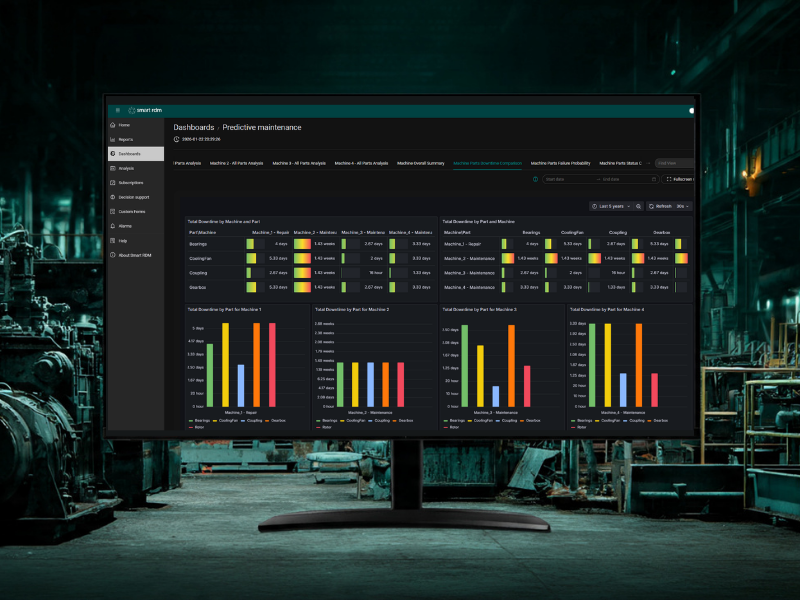
3) Failure prediction: “Maintenance is firefighting, and downtime costs keep rising”
Situation: CMMS/EAM has schedules and tickets, but lacks a strong link to equipment operating conditions. The historian has vibrations, temperatures, motor currents, but context is missing: operating mode, load, recipe, start/stop, service interventions. As a result, prediction remains a pilot “on one bearing,” not a plant-scale solution. How Smart RDM does it:
- Connects maintenance data (tickets, failures, inspections) with OT data (signals, trends, states).
- Builds features such as: time in overload, number of starts, time operating under low lubrication (indirectly), temperature rise vs baseline, current drifts.
- Deploys simple models/alerts (not always “space-grade AI”): anomaly detection, statistical rules, remaining useful life (RUL) prediction for selected asset classes – a practical approach to condition monitoring at scale.
Effect: fewer unplanned stoppages, better planning of parts and service windows, and a shift from reactive to predictive maintenance – because signals are embedded in production context, not just “naked trends.”
Summary: tradition buys systems. Modernity builds capability.
In industry today, the winner is not the one with “more systems,” but the one who:
- turns data into decisions faster,
- scales use cases across plants,
- has consistent KPIs and governance,
- can deploy analytics and AI operationally.
MES is an important element. But modern advantage emerges when you have an industrial data platform (like Smart RDM) that lets you deliver outcomes – from predictive maintenance to ESG reporting to process optimization – in many areas at once.
Light mode