
Manufacturing data platform: complete guide (2026)

Tomasz Węgrzyn
In brief
A manufacturing data platform is a unified technological layer that ingests, standardizes, stores, and serves data from shop-floor and enterprise systems through a canonical data model. In practice, it connects OT and IT sources such as SCADA, MES, ERP, historians, PLM, LIMS, and IIoT systems so the same data can support BI, AI/ML, digital twins, GenAI assistants, natural-language query, and embedded operational apps. Most mature architectures follow the same five-layer pattern: ingestion, event brokering, canonical modeling, storage and processing, and consumption.
What is a manufacturing data platform?
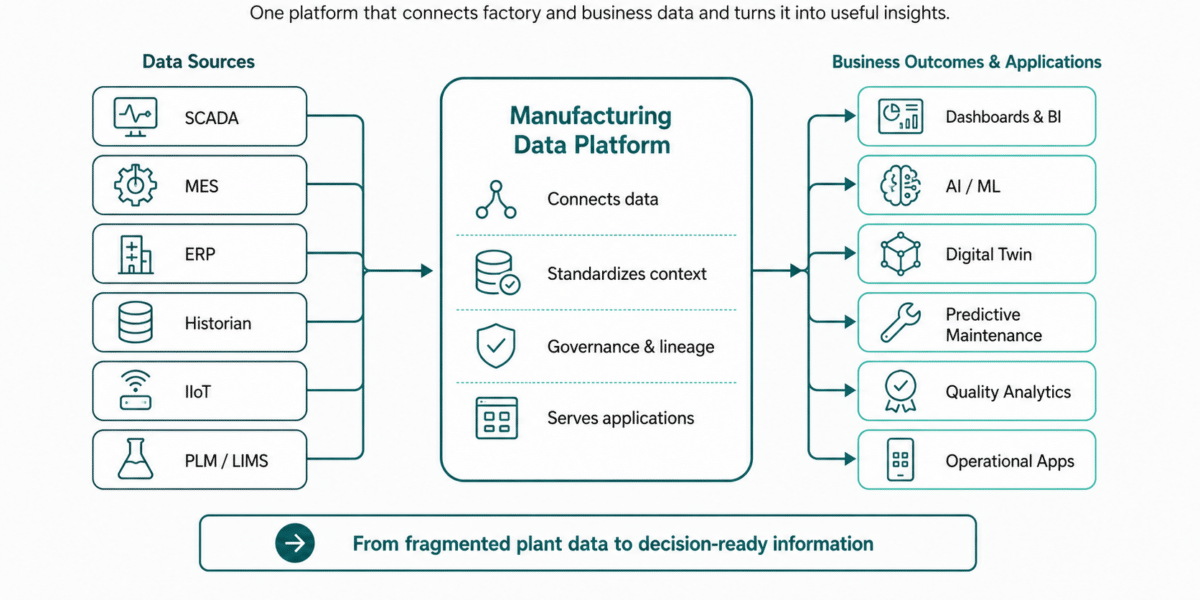
A manufacturing data platform is not just another database, dashboard layer, or cloud repository. It is a structured industrial data foundation that turns fragmented plant and enterprise data into something reusable across operations, analytics, and AI, so manufacturers do not have to remodel the same data separately for every report, model, and application.
That distinction matters because manufacturing data is inherently heterogeneous. Some of it arrives as sub-second telemetry from the shop floor. Some of it comes from MES workflows, quality records, laboratory systems, maintenance events, ERP transactions, or engineering systems. Some of it is time-series data, some event data, some document data, and some manufacturing data sets prepared for training, reporting, or benchmarking. A real manufacturing platform exists to connect those layers without stripping away the industrial meaning that makes them operationally useful.
In practical terms, a strong platform does four things well. It connects to industrial and enterprise sources, standardizes them through a canonical data model, governs access and lineage, and serves the data to applications that need it. That is the difference between manufacturing data collection and a true manufacturing data management approach. It is also the difference between manufacturing data collection software and a full production data platform.
Smart RDM fits this category because it is positioned as an industrial data and AI platform that connects OT and IT without friction, provides data quality and management, supports big data and analytics, and exposes the results through dashboards, alerts, AI-supported workflows, and knowledge tools. Its own product pages describe a complete chain from acquisition and harmonization to reporting, analysis, visualization, and AI-assisted decision support.
Where a manufacturing data platform sits in the manufacturing stack
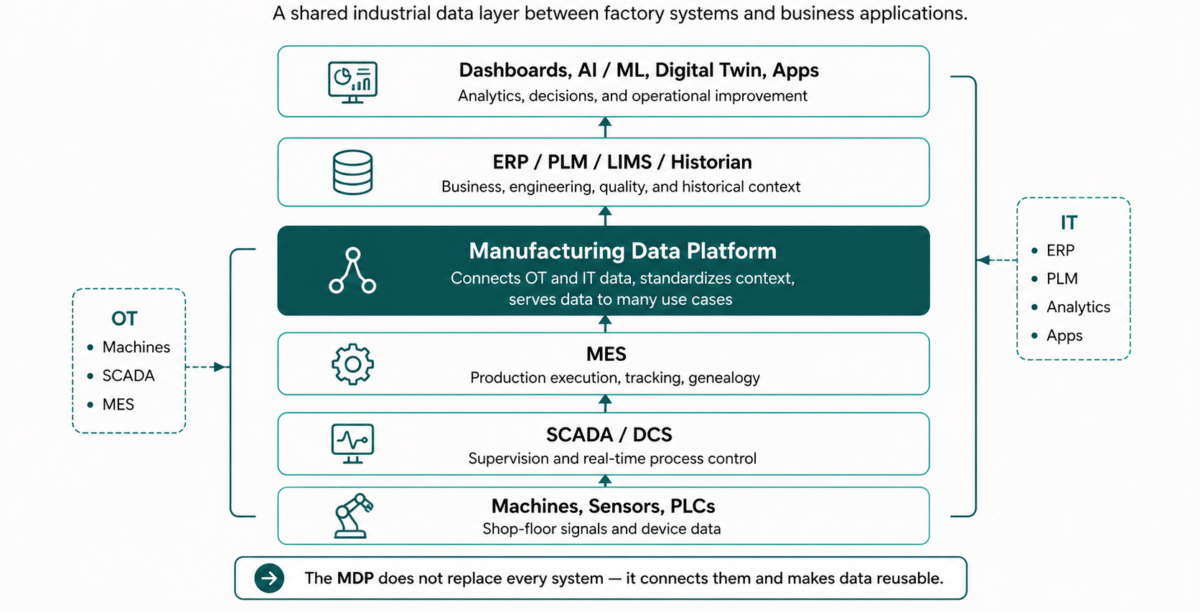
A manufacturing data platform usually sits across the boundary between operational systems and analytical systems. It does not replace every component in the industrial stack. More often, it acts as a shared layer that consumes data from systems already in place and makes that data usable across multiple business and operational contexts.
MDP vs. SCADA and DCS
SCADA and DCS systems remain the supervisory and control layer closest to the process, typically aligned with ISA-95 Level 2. They acquire signals from sensors and PLCs, handle process supervision, and work with industrial protocols such as OPC UA, OPC DA, and Modbus. A manufacturing data platform does not take over that control role. Instead, SCADA becomes a real-time telemetry source for the MDP ingestion layer, and SCADA often also feeds a historian for long-term process history.
MDP vs. MES
MES remains the execution layer of manufacturing operations, commonly aligned with ISA-95 Level 3. Its core functions include dispatching, tracking, genealogy, and recipe management. In most target architectures, MES is not replaced by a manufacturing data platform. It becomes one of the most important contextual data sources for it, while MES itself sits above SCADA in the ISA-95 stack and continues to exchange production orders and execution feedback with ERP. Representative MES vendors in this landscape include Siemens Opcenter, Rockwell, GE Digital, and Critical Manufacturing.
MDP vs. Historian
A data historian plays a different role again. It is optimized for long-term storage of process variables in a tag-based model, often with retention measured in years and with industrial compression approaches such as swinging door compression. Examples commonly cited in this category include OSIsoft PI / AVEVA, Canary, and GE Proficy. In many environments, the historian remains a system of record for process history while the MDP reads historical tags from it and combines them with broader business and operational context. That is why historian coexistence is often more realistic than immediate historian replacement.
MDP vs. ERP
ERP provides business context: orders, BOMs, master data, planning data, inventory, finance, and supply-chain structures, typically aligned with ISA-95 Level 4. Examples frequently used in industrial landscapes include SAP S/4HANA, Oracle, and Microsoft Dynamics. Without ERP context, plant signals are often analytically interesting but operationally incomplete, which is why ERP should be treated as a business data source for the MDP rather than as a separate world.
MDP vs. a Data Lake
A manufacturing data lake can store raw industrial data, but a data lake alone is not a manufacturing data platform. A pure data lake is typically schema-on-read and often built on open formats such as Parquet, Avro, and ORC. That gives it flexibility, but it does not provide native manufacturing context by itself. The MDP may use a data lake as a storage component, but the platform adds industrial structure, canonical modeling, governance, and reusable semantics on top of that raw layer.
MDP vs. a Data Warehouse
A pure data warehouse focuses on structured analytics storage, schema-on-write, and SQL/BI performance. Snowflake, BigQuery, and Redshift are common examples of warehouse-oriented or warehouse-adjacent analytics environments. A manufacturing data platform can feed a warehouse or use warehouse-style capabilities for reporting, but it is broader than a DWH because it also has to handle industrial telemetry, operational events, historian feeds, edge flows, and source-system context. Put simply: a DWH is often an analytical layer; an MDP is an operational and analytical industrial data layer.
MDP vs. an IIoT Platform
An IIoT platform is primarily focused on connectivity and device management. Typical examples include AWS IoT, Azure IoT, and PTC ThingWorx, and typical features include device provisioning, OTA updates, and edge runtime support. That overlaps with MDP architecture at the ingestion and connectivity layer, but the categories are not the same. An IIoT platform is strongest at connecting and managing devices; an MDP is stronger when the goal is to standardize, govern, and reuse data across industrial and enterprise applications.
Reference architecture: how an MDP works
Most manufacturing data platforms can be described through five layers. The first is edge and ingestion: connectors, adapters, and interfaces that pull data from sources such as OPC UA endpoints, MQTT brokers, historians, REST APIs, databases, files, PLM, LIMS, CMM systems, gauging devices, and vision systems. The second is event brokering: the message layer that decouples producers from consumers and supports real-time or near-real-time data movement. The third is canonical modeling: where raw signals, tags, events, and records are mapped into a shared industrial structure. The fourth is storage and processing: where raw, structured, and unstructured data are stored and processed. The fifth is consumption: where dashboards, AI/ML, digital twins, GenAI assistants, and embedded apps consume the data foundation.
Smart RDM maps well to this reference architecture. Its official materials describe ready-made connectors such as OPC UA, MQTT, REST, AVEVA PI API, and Edge components; a complete data processing chain from acquisition through standardization and harmonization to publication; configurable dashboards and reporting; AI-powered knowledge management; and predictive maintenance and optimization workflows built on the same industrial data flow.
Data models: ISA-95, CDM, UNS, and Digital Twin
The real differentiator in a manufacturing data platform is not raw connectivity alone. It is the data model. Industrial organizations already have many ways to collect data. What they usually lack is a shared manufacturing data model that makes data comparable across systems, lines, plants, and use cases.
ISA-95
ISA-95 remains one of the most important foundations here because it defines enterprise–control integration across levels L0–L4 and provides models for equipment hierarchy, materials, personnel, and operations. It also defines the interface logic between MES and ERP at the Level 3–Level 4 boundary. In an MDP, ISA-95 often becomes the backbone of the canonical data model because it gives manufacturers a consistent way to organize plant and business context.
Canonical data model (CDM)
A canonical data model is the internal structure that remaps source-native data into a common language for assets, operations, states, materials, events, and outcomes. Critical Manufacturing explicitly ties its data platform approach to ISA-95 and CDM thinking, and the same logic applies more broadly: the CDM is what makes cross-site benchmarking, reusable analytics, and scalable AI possible. Without it, every dashboard, every plant app, and every model has to reinterpret source data separately.
Unified namespace (UNS)
Unified Namespace is an architectural pattern in which industrial data is exposed through a single hierarchical namespace, usually with MQTT as the broker layer and with report-by-exception behavior. OASIS defines MQTT as a lightweight publish/subscribe messaging transport protocol designed for machine-to-machine and IoT contexts, which is why UNS is often discussed inside MDP ingestion and brokering architectures. Used well, UNS can reduce brittle point-to-point integrations and make multiple data consumers work from one structured event space.
Digital Twin and AAS
Digital twins sit slightly higher in the stack. ISO 23247 defines a digital twin framework for manufacturing, and the series describes a framework for creating digital twins of observable manufacturing elements. In practice, digital twin applications consume data from the MDP, or sit as a model layer above it, for monitoring, simulation, optimization, and prediction. Asset Administration Shell adds an EU-relevant pattern for compiling and structuring asset information, which is why AAS is frequently mentioned alongside digital twin and industrial interoperability discussions.
Rare but valuable standards
For semantic depth, it is worth noting a few less frequently cited but still relevant reference points. ISA-88 provides guidelines for the design and specification of batch control systems and has published guidance on integration with ISA-95. NAMUR Open Architecture aims to make production data securely usable for plant and asset monitoring and optimization, which makes it relevant to modern industrial data platforms even if it appears less often in mainstream vendor pages.
Ingestion and connectivity: OPC UA, MQTT, REST, Batch, and Edge
A manufacturing data platform has to support multiple ingestion modes because manufacturing data does not originate in one system or travel in one way. In practice, MDPs ingest data through industrial protocols such as OPC UA, messaging layers such as MQTT, application interfaces such as REST APIs, and batch sources such as files and SQL databases.
That is why manufacturing data collection software alone is not enough. Collection is only the first step. The platform also has to handle buffering, mapping, timestamping, standardization, lineage, and context enrichment. Smart RDM’s own integration pages describe this as a complete data processing chain from acquisition to publication rather than as a connector library only.
Edge computing also matters here. Some workloads require low latency close to the plant, some environments have intermittent connectivity, and some organizations must keep selected data flows on-prem for operational or regulatory reasons. That is why a modern manufacturing data integration platform should support edge runtime, cloud, on-prem, and hybrid deployment rather than assuming one universal pattern.
Storage and processing: Lakehouse, Streaming, Batch, and MLOps
Manufacturing platforms have to handle more than one time horizon. Real-time flows matter for alarms, operator visibility, anomaly detection, process monitoring, and faster-than-shift decisions. Batch and historical processing matter for trend analysis, model training, curated manufacturing data sets, compliance reporting, cross-site benchmarking, and root-cause analysis. That is why industrial data architectures rarely succeed when they are designed for only one processing mode.
This is also where lakehouse architecture becomes relevant. In practice, the lakehouse idea is useful because it combines data-lake flexibility with stronger table semantics for analytics and AI. Common open table formats in this conversation include Delta Lake, Apache Iceberg, and Apache Hudi. Delta Lake emphasizes ACID transactions and schema enforcement, Iceberg emphasizes full schema evolution, and Hudi emphasizes incremental processing and low-latency analytics. In an MDP, a data lakehouse often becomes the storage and query component of the broader architecture rather than the full platform by itself.
MLOps matters for the same reason. Once AI/ML is part of the platform, manufacturers need more than notebooks and proof-of-concept models. They need governed data pipelines, model publishing, retraining, monitoring, and repeatable movement from pilot to production. Smart RDM’s analytics and AI pages position the platform around parameterized algorithms, model execution, result publishing, and AI-assisted operational support, which is functionally much closer to an MLOps-ready industrial environment than to isolated experiments.
Consumption layer: BI, AI/ML, Digital Twin, GenAI, and Apps
The value of an MDP appears in the consumption layer. This is where standardized data becomes usable in BI tools, dashboards, AI/ML workflows, digital twins, GenAI assistants, natural-language query, and embedded operational applications. An MDP consumption layer should explicitly deliver data to BI / dashboards, AI/ML models, digital twin applications, and GenAI assistants, not just leave data sitting in storage.
For BI and dashboards, the goal is not only visibility but consistent visibility. A platform like Smart RDM lets users create configurable dashboards and recurring or event-driven reports in the same environment where the data is already contextualized.
For AI/ML, the same foundation supports predictive maintenance, anomaly detection, yield optimization, and AI-supported recommendations. For digital twin use cases, the same data model supports simulation and scenario reasoning. For GenAI, the semantic grounding layer becomes critical: assistants become more useful when they can work not only with documents and manuals, but also with governed operational context.
Governance, security, and compliance
No OT/IT data platform is complete without governance. Once industrial and enterprise data start flowing into one shared environment, data lineage, identity and access management, two-factor authentication, device authentication, observability, and auditability stop being optional. They become part of the architecture itself. DAMA explicitly treats governance, quality, and security as core functions of data management, and the same principle applies in manufacturing.
That is also where cybersecurity enters the design in a practical way. The NIS2 Directive establishes a unified legal framework for cybersecurity in 18 critical sectors across the EU. ISO/IEC 27001 defines requirements for information security management systems. ISA/IEC 62443 defines requirements and processes for implementing and maintaining secure industrial automation and control systems. For an industrial data platform, these are not peripheral concerns. They directly shape what can be deployed in manufacturing and infrastructure environments.
For that reason, MDP evaluation should explicitly include IAM, network segmentation, OT firewalls, lineage, observability, audit readiness, and compliance handling. In industrial environments, security is not an add-on after deployment. It is part of what makes the platform deployable in the first place.
Use cases an MDP should support
A manufacturing data platform is valuable because one shared data layer can support multiple use cases without rebuilding integration each time. The most important thing is to describe each use case in terms of inputs, processing, and outputs.
Predictive Maintenance
Inputs: vibration, temperature, current, runtime, maintenance history.
Processing: regression, anomaly detection, probability-of-failure models, RUL logic.
Outputs: alert, RUL estimate, maintenance recommendation, guided action workflow. Smart RDM’s predictive maintenance pages explicitly describe OT/IT data, AI/ML algorithms, expert knowledge, time-to-failure logic, and operator guidance from signal to service action.
Quality control and vision
Inputs: images from the line, process parameters, machine state, production context, vision systems.
Processing: computer vision, deep learning, anomaly detection, context-aware analytics.
Outputs: defect classification, sorting decisions, traceability, process-quality correlation. Smart RDM’s manufacturing pages explicitly describe predictive quality, anomaly detection, and full operational context for quality analysis.
Yield optimization
Inputs: setpoints, recipe data, throughput, quality outcomes, operating context.
Processing: predictive and prescriptive analytics, scenario comparison, optimization logic.
Outputs: recommended parameter changes, better yield, fewer losses, higher stability. This is where a manufacturing platform moves from reporting into decision intelligence.
Closed-loop process control
Inputs: metrology, CMM, gauging data, machine measurements.
Processing: feedback rules, ML-assisted correction logic, parameter update routines.
Outputs: corrected offsets, improved machining accuracy, fewer process errors. Renishaw’s manufacturing data platform positioning is especially strong in this process-and-metrology loop.
Energy and ESG
Inputs: energy meters, emissions data, water use, production context.
Processing: aggregation, analytics, normalization, automated reporting logic.
Outputs: ESG reports, energy optimization, waste reduction, measurable environmental support. Smart RDM explicitly positions itself around ESG reporting, energy monitoring, and waste reduction based on operational data.
Cross-site benchmarking
Inputs: KPI data from multiple plants, lines, or assets.
Processing: normalization through CDM aligned with ISA-95.
Outputs: comparable OEE, yield, downtime, or quality benchmarking. Without a canonical data model, cross-site benchmarking is often inconsistent; with one, it becomes scalable.
Supply chain visibility
Inputs: inventory, supplier data, ERP context, IoT events.
Processing: forecasting, visibility logic, alerts.
Outputs: demand forecast, delay warnings, better coordination across the value chain. This is where ERP, operational signals, and manufacturing context have to work together rather than separately.
Knowledge management and GenAI
Inputs: documentation, manuals, logs, alarms, notes, process context.
Processing: RAG, LLM, semantic indexing, knowledge extraction.
Outputs: semantic search, AI assistant, guided answers, better knowledge reuse on the shop floor. Smart RDM explicitly describes this category as AI-powered knowledge management grounded in industrial data and documentation.
Comparison table: MDP vs. Data Lake vs. DWH vs. MES vs. Historian
The table below translates the brief’s required comparisons into a factual summary based on standards and vendor documentation.
| System | Primary role | Typical model | Typical strength | Typical limitation |
| Manufacturing Data Platform | Unified industrial data layer across OT and IT | Canonical data model, often aligned to ISA-95 | Reusable data for analytics, AI, apps, dashboards | Depends on integration and governance maturity |
| Data Lake | Raw data storage | Schema-on-read; often Parquet, Avro, ORC | Flexible storage of raw data | No native manufacturing context |
| Data Warehouse | Structured analytics storage | Schema-on-write; SQL/BI optimized | Reporting and analytical query performance | Less suited to raw industrial telemetry and edge-driven context |
| MES | Manufacturing execution | Operational execution model at ISA-95 Level 3 | Dispatching, tracking, genealogy, recipes | Not a shared cross-system industrial data layer |
| Historian | Time-series process storage | Tag-based model | Long retention of process variables | Limited business and semantic context by itself |
Vendor landscape 2026
The current landscape includes both general-purpose data and AI vendors with manufacturing solutions and more specialized industrial data platforms. The point is not to rank them, but to understand how they position themselves and what category language they use.
| Vendor | Product | Positioning from official materials | Typical fit |
| Snowflake | AI Data Cloud for Manufacturing | Converges IT and OT data, deploys AI/ML, and shares data across the value chain | Manufacturers approaching the problem from enterprise data cloud and analytics |
| Google Cloud | Manufacturing Data Engine + Cortex | End-to-end factory-to-cloud connectivity, processing, storage, and contextualization | Organizations building factory-to-cloud data and AI patterns |
| Databricks | Data Intelligence Platform for Manufacturing | Unifies disparate data sources for industrial AI, digital supply chain, and productivity use cases | Companies approaching manufacturing through large-scale data and AI operations |
| Critical Manufacturing | Enterprise Data Platform / The Data Platform for Manufacturers | Transforms manufacturing data into a governed, ready-to-use asset with ISA-95/CDM emphasis | Manufacturers focused on structured enterprise-wide manufacturing intelligence |
| Sight Machine | Manufacturing data platform / standardized AI-ready foundation | Transforms messy plant data into standardized, AI-ready models in real time | Plants scaling consistent manufacturing data models across sites |
| Progress | Data Platform for Manufacturing | Accelerates data, AI, and analytics projects on top of an AI-ready data platform | Enterprises approaching manufacturing from broader data platform modernization |
| Renishaw | Renishaw Central | Smart manufacturing data platform for process and metrology data | Precision manufacturing, metrology, gauging, corrective process loops |
| dataPARC | PARCview / PARCserver / industrial intelligence platform | Combines historian, analytics, and visualization capabilities for industrial data | Operations focused on process intelligence and industrial analytics |
| Smart RDM | Industrial Data & AI Platform | Connects OT and IT, governs industrial data flow, and supports dashboards, analytics, AI, ESG, and knowledge workflows | Manufacturers that need one platform across integration, analytics, reporting, AI, and operations |
What to look for when choosing an MDP
A strong manufacturing data platform should first solve connectivity without creating a brittle integration project. That means support for OPC UA, MQTT, REST, file/SQL batch flows, historian access, enterprise integration, and realistic coexistence with legacy environments. Platforms that assume a clean-sheet architecture rarely match plant reality.
Second, it should provide a usable industrial data model rather than just a storage bucket. If the platform cannot preserve context across assets, processes, orders, events, states, materials, and outcomes, it will push complexity downstream into dashboards, custom code, and AI projects. This is where manufacturing data engineers, OT engineers, and data engineers all become important: the job is not only moving data, but structuring it so it stays usable.
Third, it should support multiple consumption modes. Modern manufacturers do not need just one dashboard or one model. They need BI, alerts, apps, AI workflows, digital twin use cases, semantic assistants, and embedded operational tools built on top of one trusted foundation.
Fourth, it should be governable and deployable under real industrial constraints. That includes on-prem, cloud, and hybrid deployment options; SaaS, managed, or self-hosted delivery patterns; and security practices aligned with industrial cybersecurity expectations. On cost, the most common commercial models are per-tag, per-site, per-user, and consumption-based models, often combined with services and implementation scope.
Implementation patterns: 90 / 180 / 365 days
A typical implementation timeline is phased rather than all-at-once. In the first 90 days, teams usually choose a pilot area, connect initial OT and IT sources, define the first canonical model scope, and publish the first dashboards or governed data products. By 180 days, they add more context from MES, ERP, and historians, stabilize data quality, and launch the first analytical or AI-supported use case. By 365 days, the platform usually expands into multi-site benchmarking, broader governance, and more advanced use cases such as digital twin or GenAI assistance.
That is also why build-vs-buy decisions matter. Building internally can make sense where a company has strong data engineering, OT engineering, and industrial AI capabilities. Buying or adopting a platform is often faster where the main bottleneck is not software talent, but the need to operationalize governed data flows and use cases sooner. In practice, many teams use a hybrid path: buy the platform layer, customize the data model and applications around it.
FAQ
What is a manufacturing data platform?
A manufacturing data platform is a unified industrial data layer that ingests, standardizes, stores, and serves data from OT and IT systems through a canonical data model so the same data can support reporting, analytics, AI, digital twins, and operational applications.
What is the difference between an MDP and a data lake?
A data lake stores raw data, usually with schema-on-read, while an MDP adds manufacturing context, canonical modeling, governance, and reusable semantics on top of storage. In other words, a manufacturing data lake can be a component of an MDP, but it is not the full platform.
What is the difference between an MDP and MES?
MES is the execution layer of manufacturing operations, typically at ISA-95 Level 3, while an MDP consumes MES data and combines it with SCADA, historian, ERP, and other sources for broader analytical and operational reuse. MES manages execution; MDP manages reusable industrial data context.
What is the difference between an MDP and a historian?
A historian specializes in tag-based time-series storage with long retention of process variables. An MDP can read historian data, but extends it with business context, governance, cross-system modeling, and broader application support.
What is a canonical data model in manufacturing?
A canonical data model is a standardized internal representation of industrial entities, events, states, materials, and relationships. It is what makes data comparable and reusable across systems, plants, dashboards, and AI models.
What is ISA-95?
ISA-95 is a standard for integrating enterprise and control systems. It structures manufacturing information across levels L0–L4 and defines models such as equipment hierarchy, materials, personnel, operations, and Level 3–Level 4 interfaces.
What is a Unified Namespace?
A Unified Namespace is an architectural pattern in which industrial data is exposed through a single hierarchical namespace, usually using MQTT as the broker layer and report-by-exception behavior to make events visible to multiple consumers.
Is an MDP the same as an IIoT platform?
No. An IIoT platform focuses mainly on connectivity, device management, provisioning, OTA updates, and edge runtime. An MDP is broader: it standardizes and governs data so it can be reused across industrial and business applications.
How do MDPs ingest data from OPC UA, MQTT, and historians?
They typically use connectors, brokers, APIs, adapters, and edge components. OPC UA is widely used for industrial interoperability, MQTT for lightweight publish/subscribe messaging, and historians are often connected as time-series sources that the MDP reads and contextualizes.
How does edge computing fit into an MDP?
Edge computing supports low-latency handling, local buffering, intermittent connectivity, and selective on-prem processing. In practice, it belongs in the ingestion layer and is especially useful where data cannot or should not move directly to cloud services.
How does a lakehouse architecture apply to manufacturing?
A lakehouse helps manufacturing platforms handle raw, structured, and unstructured data in one architecture while adding stronger semantics such as ACID transactions, schema enforcement, and schema evolution. Formats such as Delta Lake, Iceberg, and Hudi are often used in this layer.
How do MDPs integrate with MES, SCADA, ERP, and PLM?
By treating them as sources of different types of context. SCADA provides real-time telemetry, MES provides execution context, ERP provides business context, and PLM provides engineering or product context. The MDP standardizes those layers into one reusable industrial structure.
How should a company choose an MDP?
It should evaluate connectivity, industrial data modeling, support for real-time and batch processing, governance, security, deployment flexibility, application support, and coexistence with MES and historians. The best platform is the one that fits the plant architecture and operating model, not the one with the broadest generic feature list.
What MDPs are available in 2026?
The current market includes Snowflake, Google Cloud, Databricks, Critical Manufacturing, Sight Machine, Progress, Renishaw, dataPARC, and Smart RDM, among others. They differ mainly in where they enter the problem: cloud data, analytics, manufacturing operations, industrial connectivity, or governed OT/IT data flow.
Cloud-native vs. on-prem MDP: what are the trade-offs?
Cloud-native platforms are usually easier to scale and faster to iterate, while on-prem deployment can be more suitable where latency, plant isolation, or regulatory constraints matter. In manufacturing, hybrid deployment is often the practical answer because not all data and workloads belong in the same place.
How much does an MDP cost?
There is no universal pricing model. Common commercial models include per-tag, per-site, per-user, and consumption-based pricing, often combined with implementation, integration, and support scope. Total cost depends as much on data modeling and rollout complexity as on license format.
What skills does the team need?
A strong team usually includes a manufacturing data engineer or data engineer, an OT engineer, an architect or platform engineer, and when AI is in scope, an ML engineer or data scientist. What matters most is the ability to connect plant reality, data structure, and business use.
What happens to legacy historians after MDP adoption?
Usually one of three things: they coexist with the MDP, they are partially abstracted behind it, or they are gradually migrated. In practice, coexistence is often the most realistic starting point because historians still play an important role in process history retention.
Can an MDP work without replacing MES?
Yes. In many architectures, MES remains in place and becomes one of the platform’s most important contextual sources. Replacing MES is a separate architectural decision, not a prerequisite for MDP value.
What are common failure modes of MDP projects?
The most common failure modes are poor data quality, missing operating context, no clear ownership, and weak linkage between analytics and action. Smart RDM’s own writing on predictive maintenance and AI failures repeatedly points to data quality, context, and decision workflow as the difference between a pilot and a scalable outcome.
What are the 4 pillars of data management?
There is no single universal four-part taxonomy, but in practice most industrial teams organize data management around governance, quality, security, and access/use. DAMA explicitly treats governance, quality, and security as core functions, and MDP implementations add operational access and reuse as the practical fourth pillar.
What are the 5 components of data management?
A practical five-part model for manufacturing data management is collection, standardization, storage, governance, and consumption. That aligns closely with the five-layer architecture used in many manufacturing data platform designs.
What are the three major activities of MDM?
If MDM here means master data management, the three major activities are usually defining master entities, governing and cleansing them, and synchronizing them across systems. In manufacturing, that often affects assets, materials, BOM-related context, and master structures coming from ERP, MES, or PLM.
What is manufacturing analytics?
Manufacturing analytics is the use of operational and business data to understand, improve, and optimize manufacturing performance. In practice, it spans KPI reporting, anomaly detection, predictive models, quality analysis, root-cause analysis, and prescriptive decision support.
What are the 4 types of analytics?
The most common classification is descriptive, diagnostic, predictive, and prescriptive analytics. In manufacturing, those map naturally to reporting what happened, understanding why it happened, estimating what is likely to happen next, and recommending what should be done.
What does a manufacturing analyst do?
A manufacturing analyst turns production, quality, maintenance, and supply-chain data into actionable insights. In practice, that includes identifying problems, designing analyses, working with OEE or process performance, and translating findings into operational recommendations.
What are the 7 sectors of manufacturing?
There is no single official seven-part split used everywhere, but a practical industrial grouping includes process manufacturing, discrete manufacturing, food and beverage, chemicals, pharmaceuticals, metals and heavy industry, and utilities- or infrastructure-adjacent industrial operations. For MDP strategy, the exact taxonomy matters less than the fact that each sector creates different data types, regulatory needs, and integration patterns.
Final takeaway
A manufacturing data platform is best understood as a reusable industrial data foundation, not as a single application. Its role is to connect OT and IT sources, standardize them through a canonical data model, and make them usable across analytics, AI/ML, digital twins, dashboards, and operational applications. The technology choices will vary, but the core pattern remains the same: connect, contextualize, govern, and serve industrial data at scale.
Smart RDM fits this category most convincingly when it is presented clearly: not as just a dashboard tool, not as just a reporting system, and not as just an AI layer, but as an industrial data and analytics platform that integrates plant and enterprise data, governs it, and turns it into decision-ready operational context. That positioning is stronger because it reflects how manufacturers actually buy and use industrial data platforms: as foundations for many use cases, not as isolated point tools.

Light mode