

Industrial energy management with Smart RDM: minimum production cost under variable tariffs, weather, and production conditions

Marek Zając
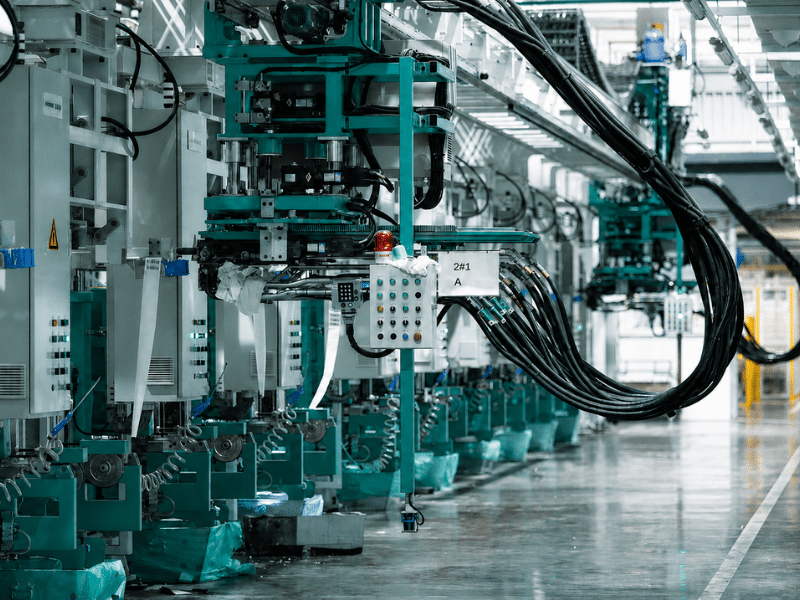
In manufacturing plants, industrial energy management is increasingly becoming just as decisive for the cost of production as raw materials or line efficiency. Price volatility, time-of use (TOU) tariffs, peak demand charges, process quality requirements, seasonality, and the impact of weather on demand all mean that “energy” is no longer merely a line item in a monthly report, but a production control parameter.
By industrial energy management – or energy balancing, in the operational sense – we mean the ability to achieve the lowest possible production cost under specific plant operating conditions, using the available mix of energy carriers and sources: grid electricity, natural gas, biomass, on-site renewables, in-house cogeneration (combined heat and power, CHP), and – where available – battery energy storage systems (BESS) and heat recovery systems. Smart RDM is an industrial energy management software platform that combines OT and IIoT data with the realities of plant energy systems and translates them into real-time operational decisions – effectively an energy management system (EMS) built for data-driven manufacturing.
From OT data to the plant energy model
In a typical manufacturing plant, energy data comes from multiple sources: submeters and smart power meters at switchboards, utility meters, WAGES measurement systems (water, air, gas, electricity, steam), PLC/SCADA/DCS systems providing operating states, time-series historian data and production context, as well as source systems for in-house generators (cogeneration/CHP, boiler house, solar PV). Value is created only when this data is time-consistent, described using a common semantic layer, and embedded within the plant structure.
Smart RDM operates on both historical and real-time data, based on a high-performance time-series data repository and an object model (semantic data model) of the installation. The object model provides full data contextualization – it structures the plant in a way that is understandable for energy management and maintenance: sources, distribution nodes, sections, lines, areas, critical loads, and auxiliary media (WAGES). Each element has its own attributes, relationships, and calculation rules. As a result, energy KPI calculations – including specific energy consumption (SEC), energy intensity, and kWh per unit of output – are not a series of manual reports but a repeatable mechanism operating in the background, forming the backbone of a modern energy performance indicator (EnPI) framework.
An integral part of the solution is data quality management: alignment with 15-minute settlement windows (the standard for dynamic tariffs and time-of-use pricing), operation based on quality flags, anomaly detection in measurement streams, unit normalization, and – where necessary – application of substitution logic (e.g., estimation) with explicit marking of the confidence level. In practice, it is data quality that determines whether energy managers and IT/OT teams treat the system as an operational tool.
Energy cost optimization in a production context
A plant with multiple carriers and sources operates under process and operational constraints: fuel availability, generator efficiency, minimum run times, power ramp rates, emission limits, contracted capacity (connection) limits, and process requirements. At the same time, external conditions apply: TOU tariff periods (on-peak and off-peak), wholesale energy prices (with dynamic tariffs approaching), and weather affecting loads (e.g., HVAC, cooling, sensitive processes) and renewable generation. In addition, there are production plans, changeovers, startups, and technological cycles.
In this context, energy cost optimization means selecting such a plant operating scenario in which the energy cost per unit of production (kWh/unit and specific energy consumption) is minimized while maintaining process safety and quality. Smart RDM enables linking the energy profile with production context – much like a digital twin of plant energy – and simulating and comparing variants: with a higher share of in-house cogeneration/CHP, with renewable priority in selected hours, with biomass use in defined periods, or with grid consumption optimized for TOU periods and contracted-capacity limits. Variant modeling is based on historical data, the current status of sources, and technological constraints defined in the model.
The scenario layer in Smart RDM translates balancing into daily operational decisions. Based on historical and real-time measurements, as well as forecasts of external conditions (weather, tariff calendar, energy prices) and production data (plan, line status, changeovers), the system builds several operating variants for sources and loads. Each variant takes into account technological and energy constraints, such as power limits, ramp rates, minimum run times, fuel availability, and process priorities. The result is a set of comparable scenarios with production-adjusted costs and risks (e.g., power exceedances). The operator selects the optimal variant for the given shift, and Smart RDM tracks execution and signals deviations.
Predictive engines and advanced AI/ML algorithms – including deep learning, reinforcement learning, and multivariate regression models – enhance this process where simple rules are insufficient: forecasting power and consumption profiles in 15-minute windows, estimating renewable output, running anomaly detection across auxiliary media (WAGES), and recommending closed-loop adjustments to the energy mix in response to changing tariff and production conditions. In process industries, this is conceptually related to model predictive control (MPC) and advanced process control (APC). As a result, balancing becomes a continuous process – from scenario planning to real-time unit cost control.
The visualization layer is designed for control room and maintenance work. Smart RDM uses real-time Sankey diagrams to present energy flows between sources, distribution nodes, and loads, as well as a mimic-type synoptic view with a full plant balance, where key measurement points, current values, deviations, and statuses are visible on a single screen. This is complemented by KPI performance views and exceedance and alarm panels, enabling fast drill-down from plant level to line, node, or specific meter.
Power guardian and load profile control in settlement windows
In industrial energy management, the load profile and peak demand within settlement windows are critical. Even with constant production volume, costs may increase due to short-term peaks (driving peak demand charges), non-optimal startups, simultaneous activation of large loads, or auxiliary media operating at unfavorable times.
Smart RDM provides real-time and predictive peak-shaving and load-management mechanisms. Operationally, this means continuous monitoring of the load profile, alarming when peak thresholds are approached, and indicating context: which areas and loads are driving the current demand increase. From a predictive perspective, the system forecasts exceedance risks in upcoming time windows, considering operating states, typical startup sequences, and planned production events. This enables decisions to be made in advance: load shifting, load shedding of non-critical auxiliary media, peak shaving via BESS dispatch where available, modifying equipment startup sequences, or switching the energy mix.
In plants where additional billing components are significant (e.g., power quality parameters, reactive power profiles, and capacity charges), the model can be extended with relevant KPIs and rules, and corrective actions may also include power-factor compensation and load-profile stabilization.
Specific energy consumption: allocating energy cost to products and batches
The greatest qualitative change occurs when energy is linked to production in a way that is operationally and financially defensible. In practice, this means calculating specific energy consumption (SEC) and production-normalized energy intensity – assigning energy cost to a product, batch, order, shift, or line – taking into account not only total kWh but also operating states, startups, downtime, changeovers, and the share of shared utilities.
Smart RDM supports several allocation approaches, selected according to the level of metering and plant specifics. In the simplest version, cost is distributed proportionally to production volume. In more precise scenarios, process context is used: cost is assigned to orders and batches only during defined operating states of the line, with startups and downtime treated separately. Where more loads are metered, cost can be allocated according to the share of power and energy of individual branches within the time window.
A separate topic is shared energy: compressor stations, HVAC systems, infrastructure, and auxiliary media (WAGES). Smart RDM allows this to be treated as a departmental cost, allocated according to a defined key, or maintained as a separate energy KPI for optimization – with compressed air, HVAC, and motor systems consistently ranking among the fastest sources of industrial energy efficiency savings. Most importantly, allocation rules are transparent, repeatable, and traceable in the data.
Weather, tariff, and production conditions as optimization parameters
In plants with on-site renewables and temperature-sensitive loads, weather becomes a parameter influencing production cost. In plants operating under TOU tariffs or real-time pricing (RTP), the tariff calendar – and in more advanced systems, wholesale market price signals – also become control parameters, enabling participation in demand response and demand-side management (DSM) programs. In plants with cogeneration, biomass boilers, or other in-house sources, key factors include fuel costs, efficiency, availability, and operational constraints.
Smart RDM integrates these layers into a single operational view: production, energy, media, sources, and external conditions. This enables decision-making directly in terms of unit cost within a specific context: given a specific line operating profile, tariff zone, and the availability of renewables and on-site sources.
Smart RDM as an operational energy management system (EMS)
The key outcome of EMS implementation is the transition from observation to management. Data ceases to be a collection of charts and reports, instead becoming the foundation for a maintained plant energy model (digital twin of plant energy), real-time EnPI calculation within settlement windows, and decision support regarding the source mix and load profile. In practical terms, this results in a more stable energy cost per unit of production (kWh/unit), reduced risk of costly peak demand charges, better utilization of on-site sources, lower carbon footprint, and greater cost predictability in production planning.
Understood in this way, industrial energy management is a tool for achieving optimal production costs under changing conditions – utilizing the full mix: renewables, biomass, natural gas, grid electricity, and cogeneration/CHP – while adhering to technological constraints and the plant’s operational goals.


Light mode